
CODEPINK Webinar Reveals Radical Lessons On American Federation of Teachers' Platform
Share My Lesson gives activists a national platform to package political advocacy as classroom instruction.

QUICK TAKE-AWAY:
AFT’s Share My Lesson platform gives activist materials a union-branded pathway into classrooms.
CODEPINK activists have several lessons on American Federation of Teachers free lesson resource website. Other lessons on the site include a lesson on bin Laden’s “Letter to America” which asks students to consider why bin Laden hated Jews.Students are made into producers of activist messaging.
Presenters described lessons that move students from absorbing a specific anti-Zionist, settler-colonial analysis to creating social media-style content and finding ways to “take action.”CODEPINK’s school strategy is not operating from the margins.
The presenters and materials intersect with AFT’s Share My Lesson, CTA structures, UTLA leadership and the liberated ethnic studies movement.
FULL STORY:
The June 17 CODEPINK webinar on “Challenging Zionism in Schools” revealed not only the antisemitism at the heart of the liberated ethnic studies movement but that teacher unions have played a large role in allowing activists to shape what happens both in the unions and in the classroom.
The American Federation of Teachers (AFT) “Share My Lesson” initiative allows CODEPINK figures and other activists to circulate political materials as classroom lessons under the imprimatur of a national teachers union.
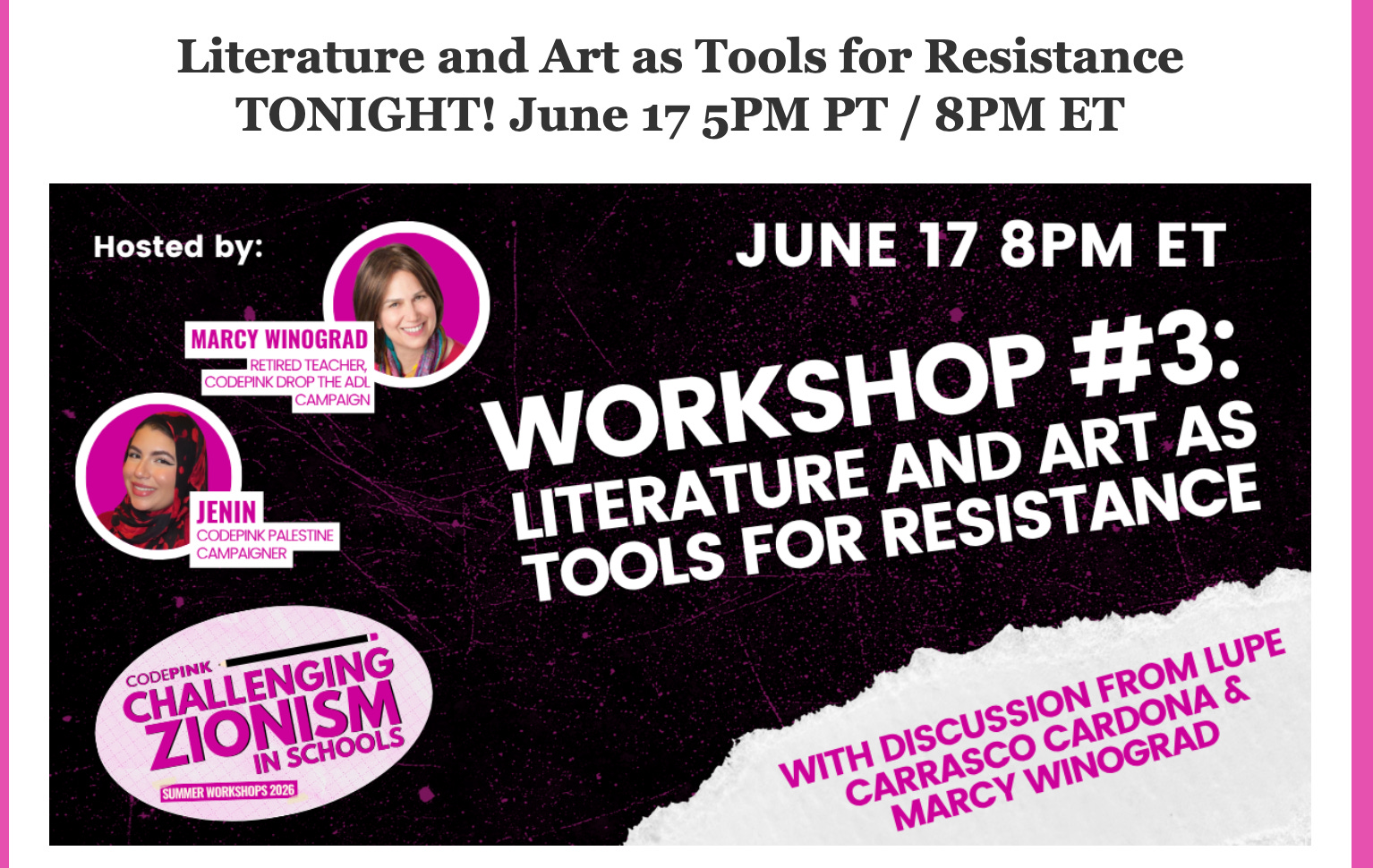
During the June 17 CODEPINK “Challenging Zionism In Our Schools” webinar, CODEPINK leader Marcy Winograd touted lessons she has put up on the AFT’s Share My Lesson website.
Winograd’s lesson asks students to analyze graffiti on Israel’s “Apartheid Wall” to learn about oppression and “what Israel has done.”
WInograd says that a rejoinder to the argument that the wall was built in response to frequent Palestinian terror attacks against Israeli civilians is that “there would not be problems if it were not for Israel’s colonization and ethnic cleansing.”
The “problems” Winograd is referring to? Blowing up civilian buses, nightclubs and restaurants.
Another lesson that Winograd has on the AFT platform provides students the following definitions of Zionism:
1)political support for the creation and development of a Jewish homeland in Israel.(Encyclopedia Britannica)
2) A settler-colonial ideology aimed at establishing a Jewish state in historic Palestine by eliminating the indigenous Palestinian people.(Palestine Policy Network–a network of Palestinian scholars)
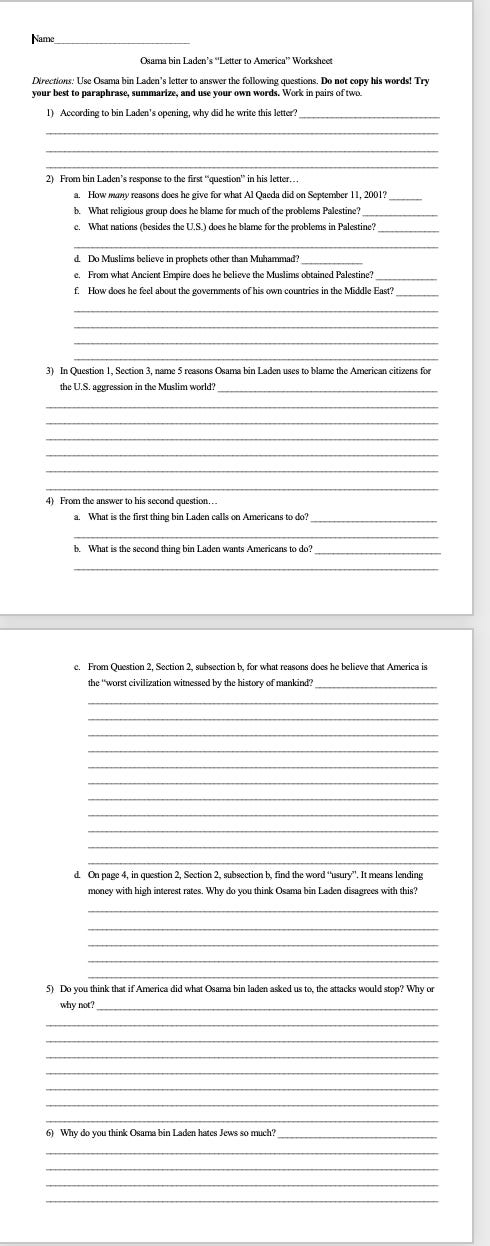
Why do you think Osama bin Laden hates Jews so much?”
Other materials available to teachers on the AFT website include a lesson on Osama bin Laden’s “Letter to America,” authored by a New York public school teacher and downloaded more than 200 times.
Students are tasked with reading bin Laden’s letter and then answering questions including: “How many reasons does he give for what Al Qaeda did on September 11, 2001”, “What religious group does he blame for much of the problems [in] Palestine?”, and “Why do you think Osama Bin Laden hates Jews so much?”
The AFT claims it does not screen content on the website and cannot review all the lessons uploaded to the site and made available to millions of its members and the public. However, it can remove lessons it sees as “any content that, in AFT’s reasonable opinion, violates any AFT policy or is in any way harmful or objectionable.”
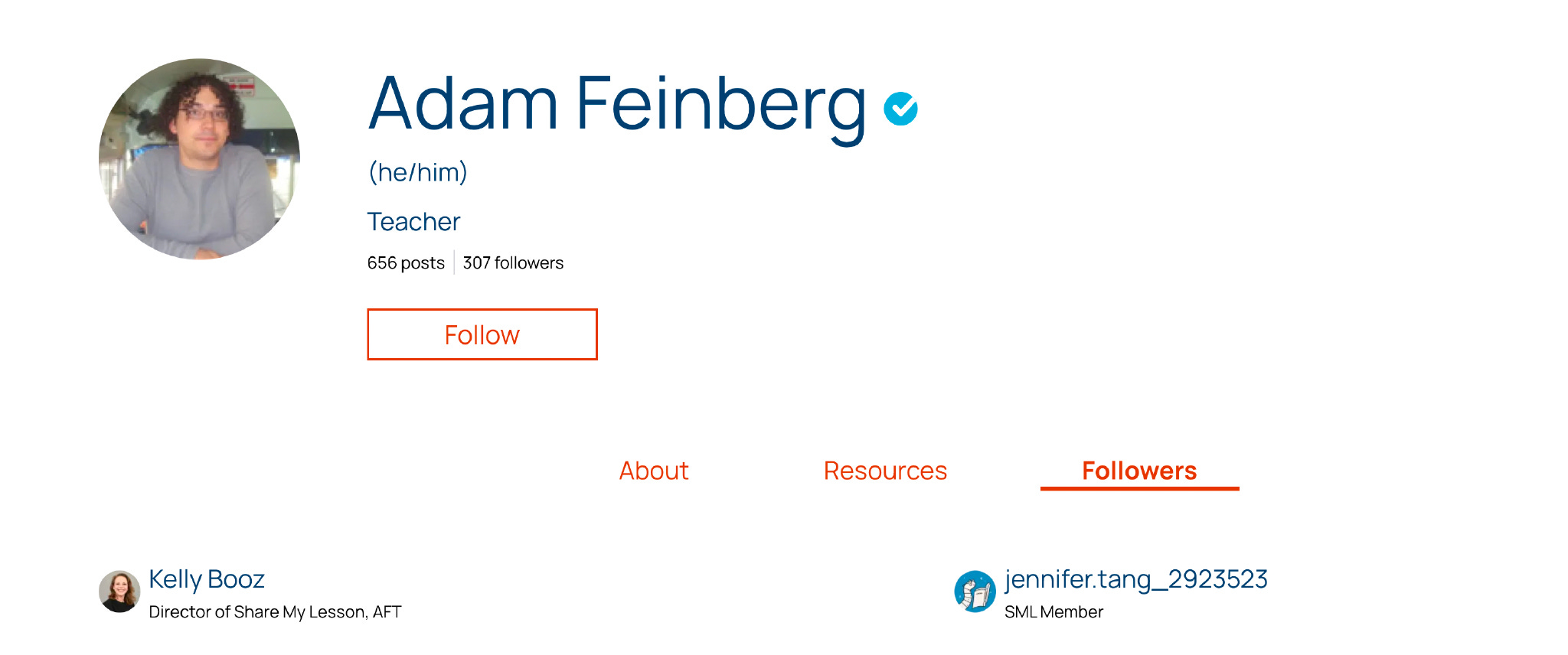
The author of the bin Laden lesson is followed by Kelly Booz, Director of Share My Lesson.
Teaching Students To Produce The Message
The theme of the webinar was “Literature and Art as Tools for Resistance.” Winograd and guest Lupe Carrasco Cardona provided overviews of lessons they have used in the classroom.
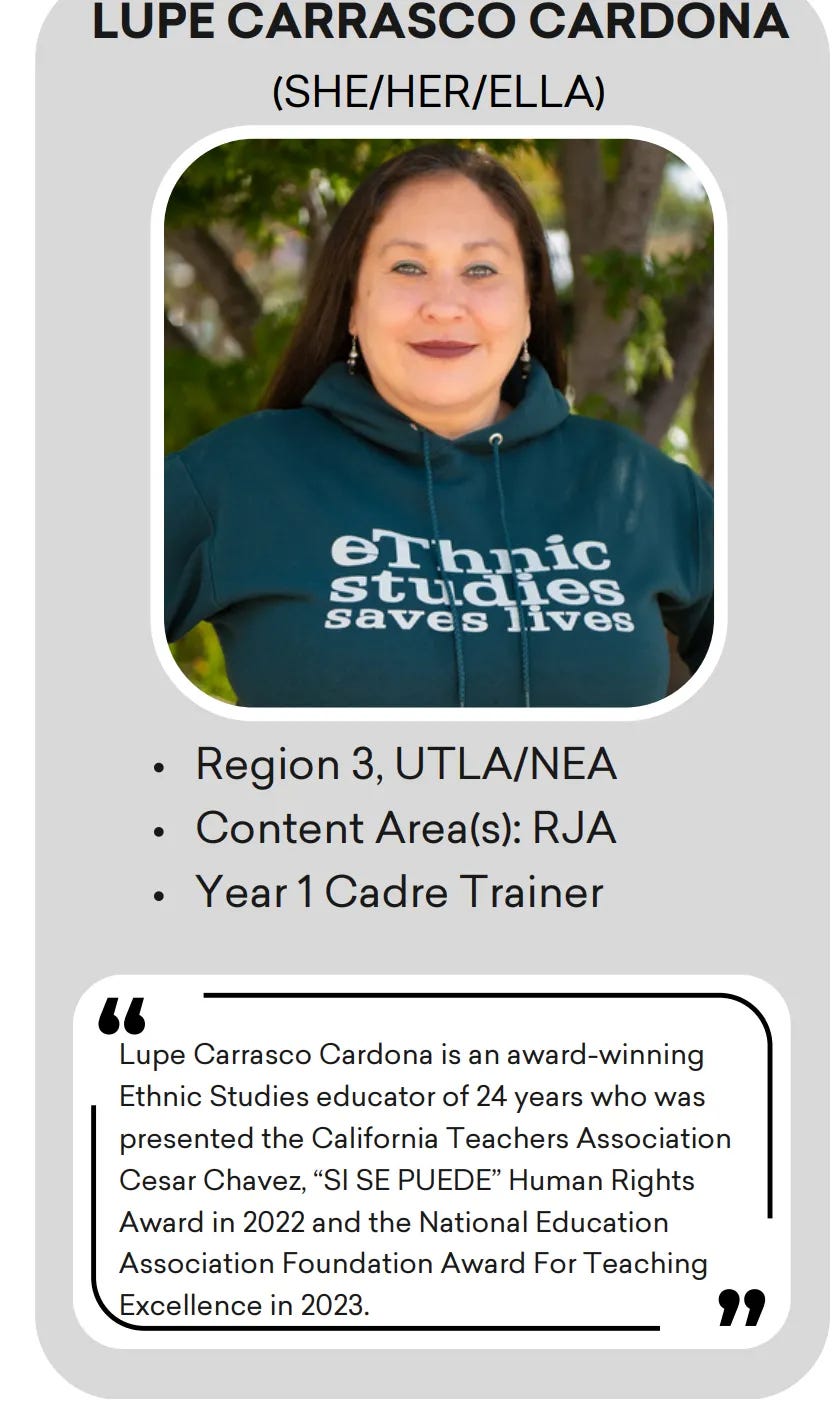
Carrasco Cardona is a founding member and president of the Liberated Ethnic Studies Model Curriculum Consortium, the group responsible for California’s model Ethnic Studies curriculum, which had to be heavily revised due to concerns about antisemitism.
At UTLA’s annual leadership conference in 2024, Carrasco Cardona was filmed suggesting that Israel intentionally placed the Star of David on its flag so that it could deflect any criticism as antisemitism.
Carrasco Cardona is co-head of the Association of Raza Educators, which describes itself as a “group of public school educators, university professors, students, and community allies committed to using education as a tool for the liberation of our community.” Dissatisfied with existing professional development opportunities for teachers, the group developed its own model that focuses on activism:
[An] Ethnic Studies/Social Justice professional development model that combines theory and practice… Led and developed for social justice educators by social justice educators who teach culturally relevant curriculum and are actively involved in organizing campaigns outside their classrooms and in their communities.
Carrasco Cardona is also engaged with Union Del Barrio’s anti-ICE efforts. These efforts are done in concert with the Community Self-Defense Coalition , of which Carrasco Cardona also appears to be a member. Carrasco Cardona has been a member of Union Del Barrio since 2015, along with her colleague Ron Gochez. The Department of Homeland Security referred to remarks Gochez made during an anti-ICE protest to the Department of Justice. Gochez said: “They [ICE] are not the only ones with guns in this city. Don’t forget that. And I don’t say that because I’m calling for violence; I’m saying that because the people have every right to defend themselves against masked, unidentified gunmen.”
Carrasco Cardona is part of the California Teachers Association’s Human Rights Department, where she is charged with training other educators on issues of “social justice.”
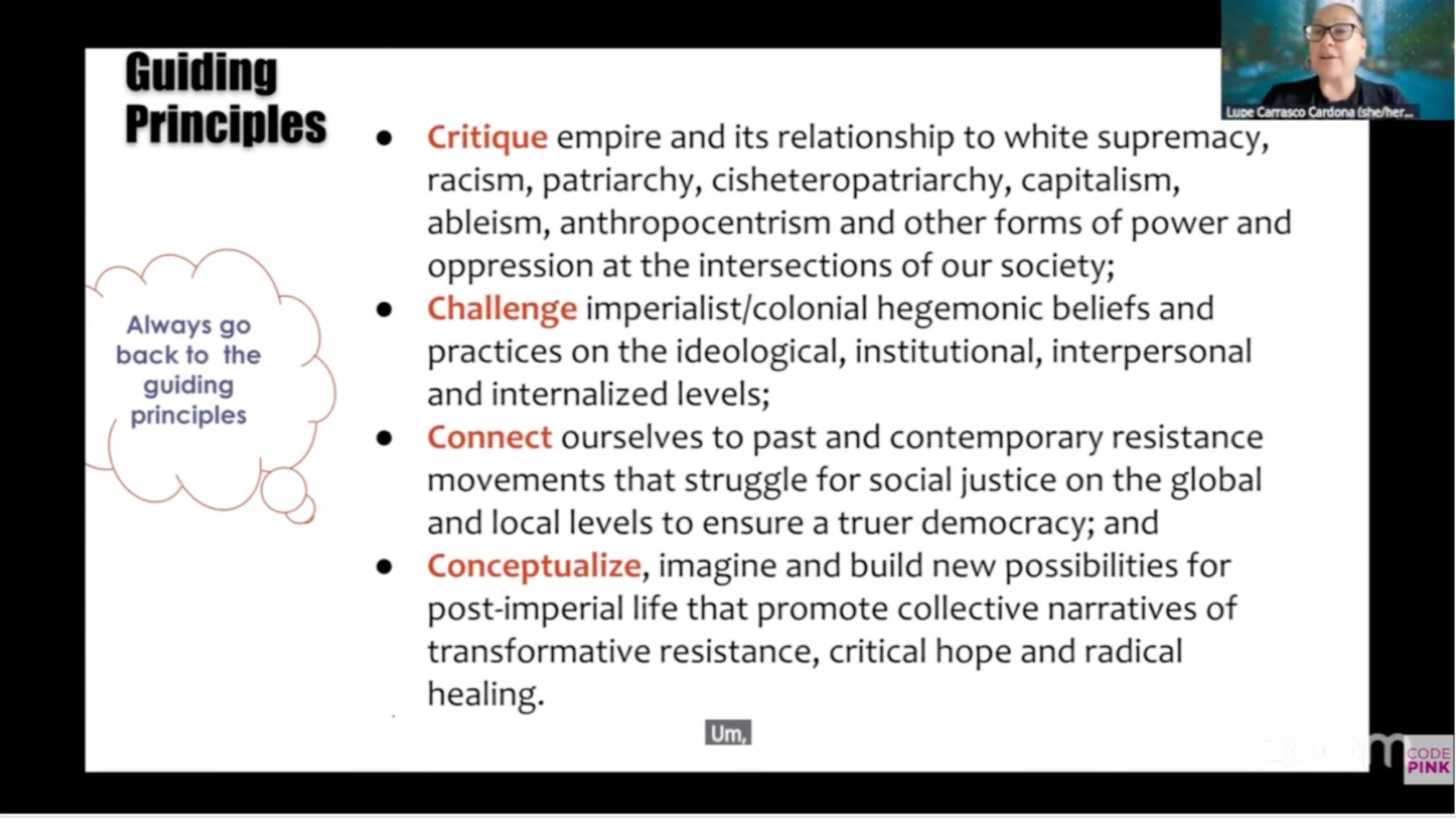
Carrasca Cardona began by sharing the guiding principles of ethnic studies
This lesson is touching on these four guiding principles. And so we always say that if your lesson doesn’t unpack one of these principles within it, then you’re probably not doing ethnic studies. You might be doing a really good diversity lesson or a very good multicultural lesson, but in order for it to be ethnic studies, it has to really do these things right? Like in this case, critique empire challenge imperialist colonial hegemonic beliefs, et cetera.
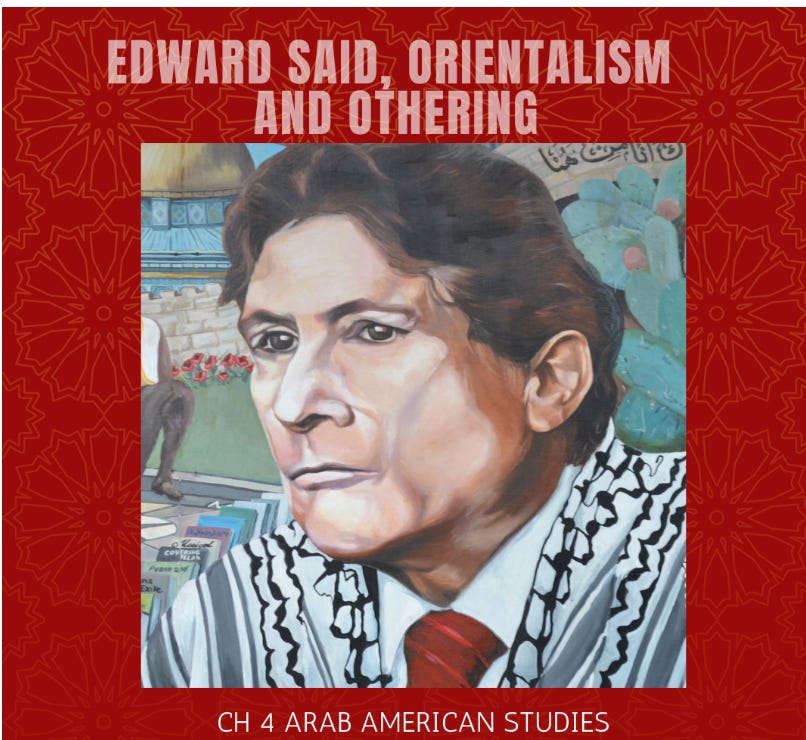
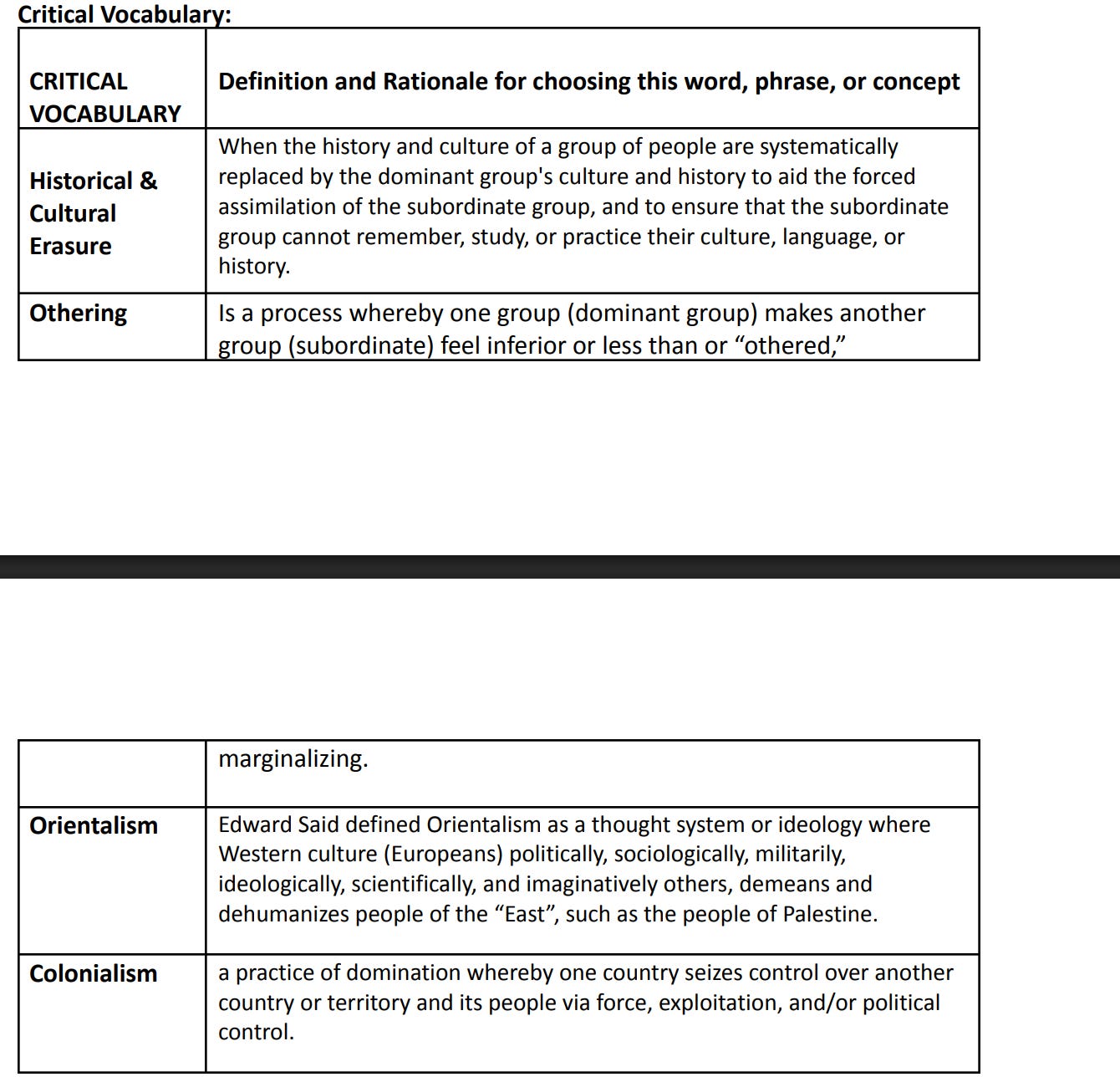
Carrasca Cardona went through her lesson plan on Edward Said which is designed for grades 7-12.
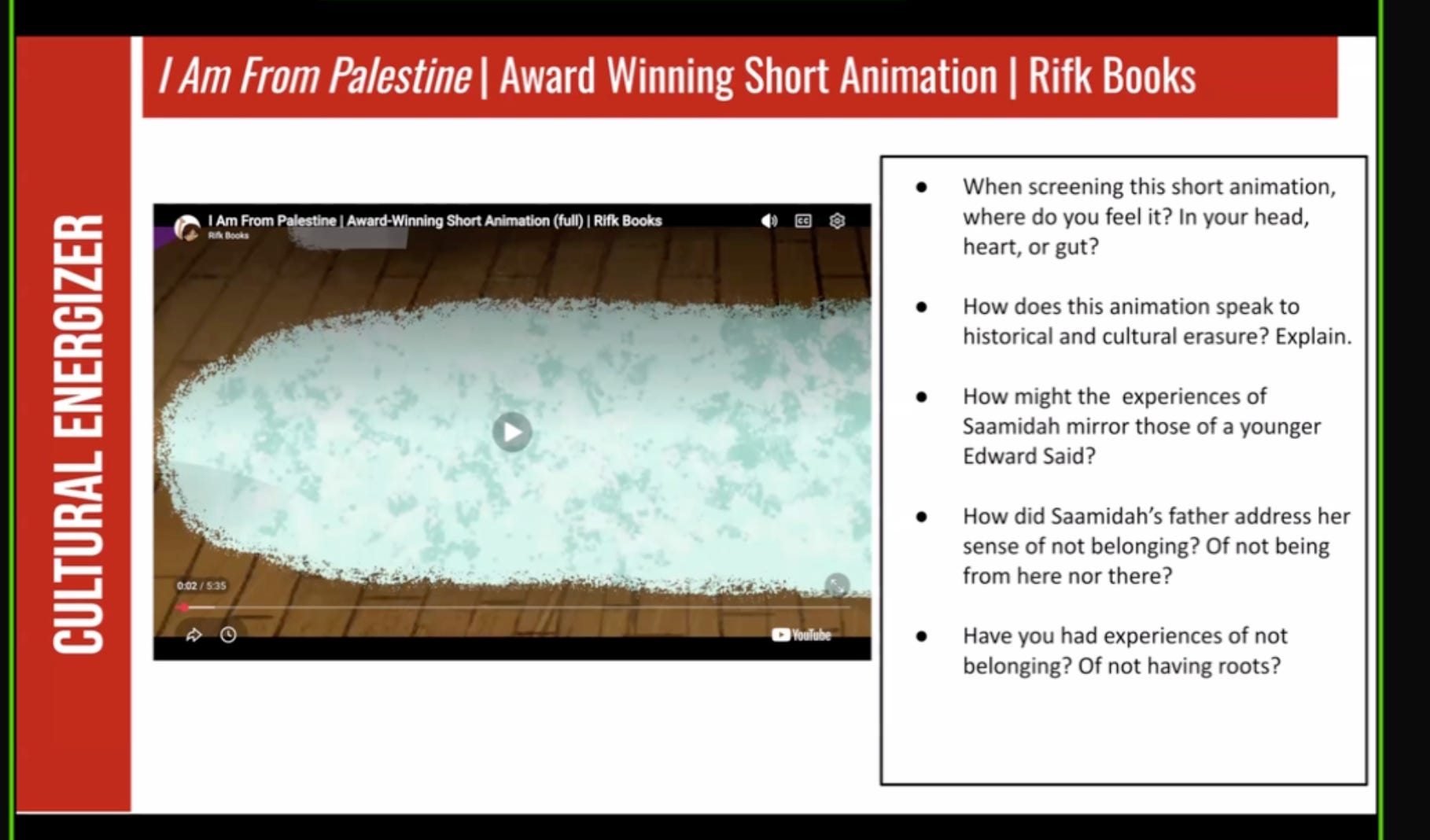
Students are shown the short film “I am from Palestine”, about a little girl who is confused when Israel, not Palestine, is shown on a map at her school. At home, her grandfather tells her she is from Jaffa (located in Israel but which he calls Palestine) and that one day they will return. She goes back to school wearing a Keffiyeh, a Palestine necklace which erases Israel, and shows her classmates a map of Israel labeled as Palestine.
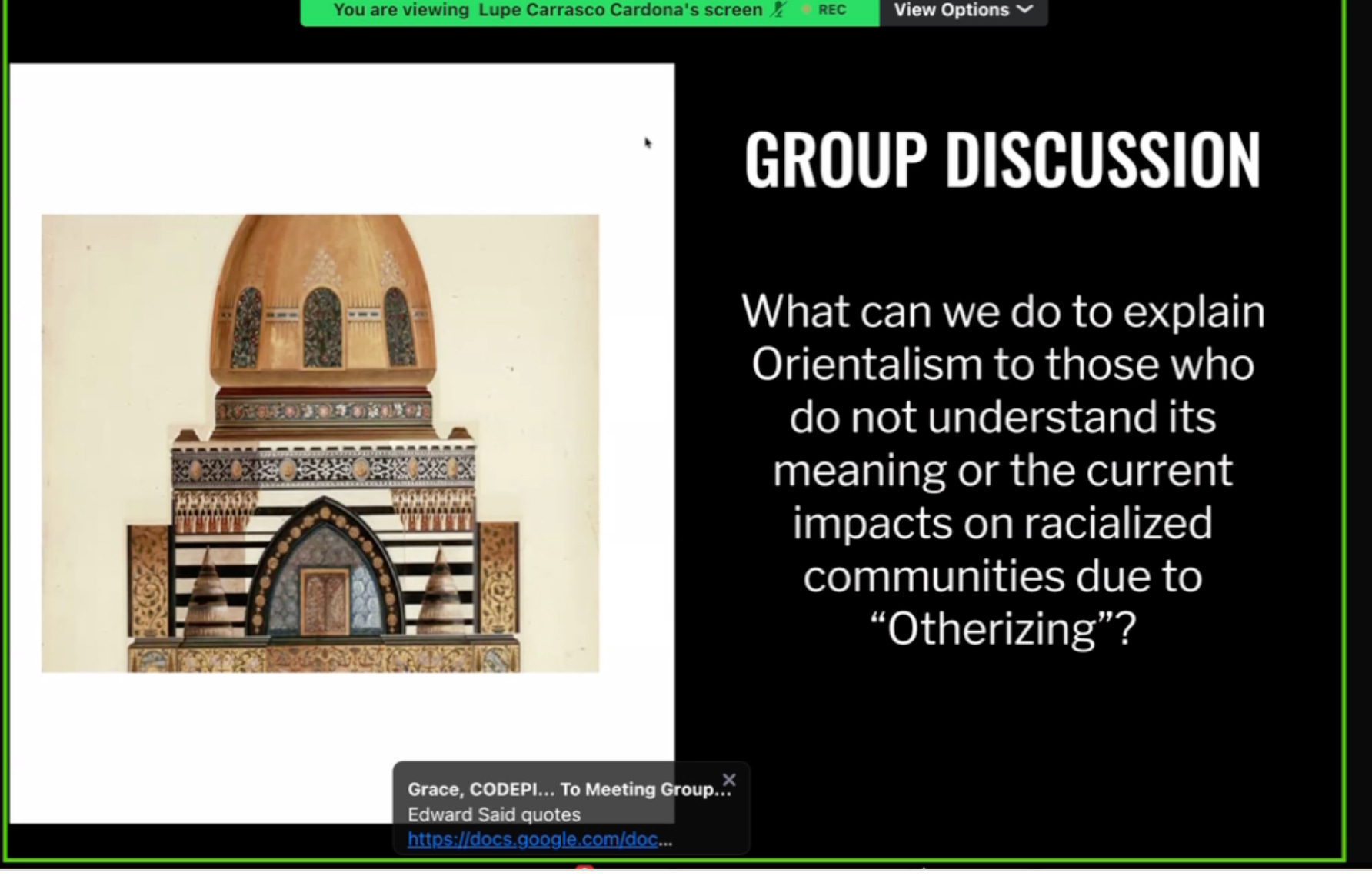
The lesson does not allow for a critical examination of Said’s concepts, instead students must adopt them and then discuss “what can we do to explain Orientalism to those who do not understand its meaning or their current impacts on racialized communities due to ‘otherizing’.”
Students are shown this video from Al Jazeera English -
And this cartoon about Orientalism.
Students don’t appear to have to actually read Said’s work. Instead, students are shown quotes from the book and then engage in “collective struggle” - they are tasked with creating a “social media meme” based on one of Said’s quotes.
The point of the lesson seems to be to encourage students to produce social media content based on Said’s ideas of Orientalism.
Some students might be very upset learning some of these things. And so we want to make sure that we provide them with that, what we call radical hope and healing. We want to provide them with a way to take action if they’re so motivated.
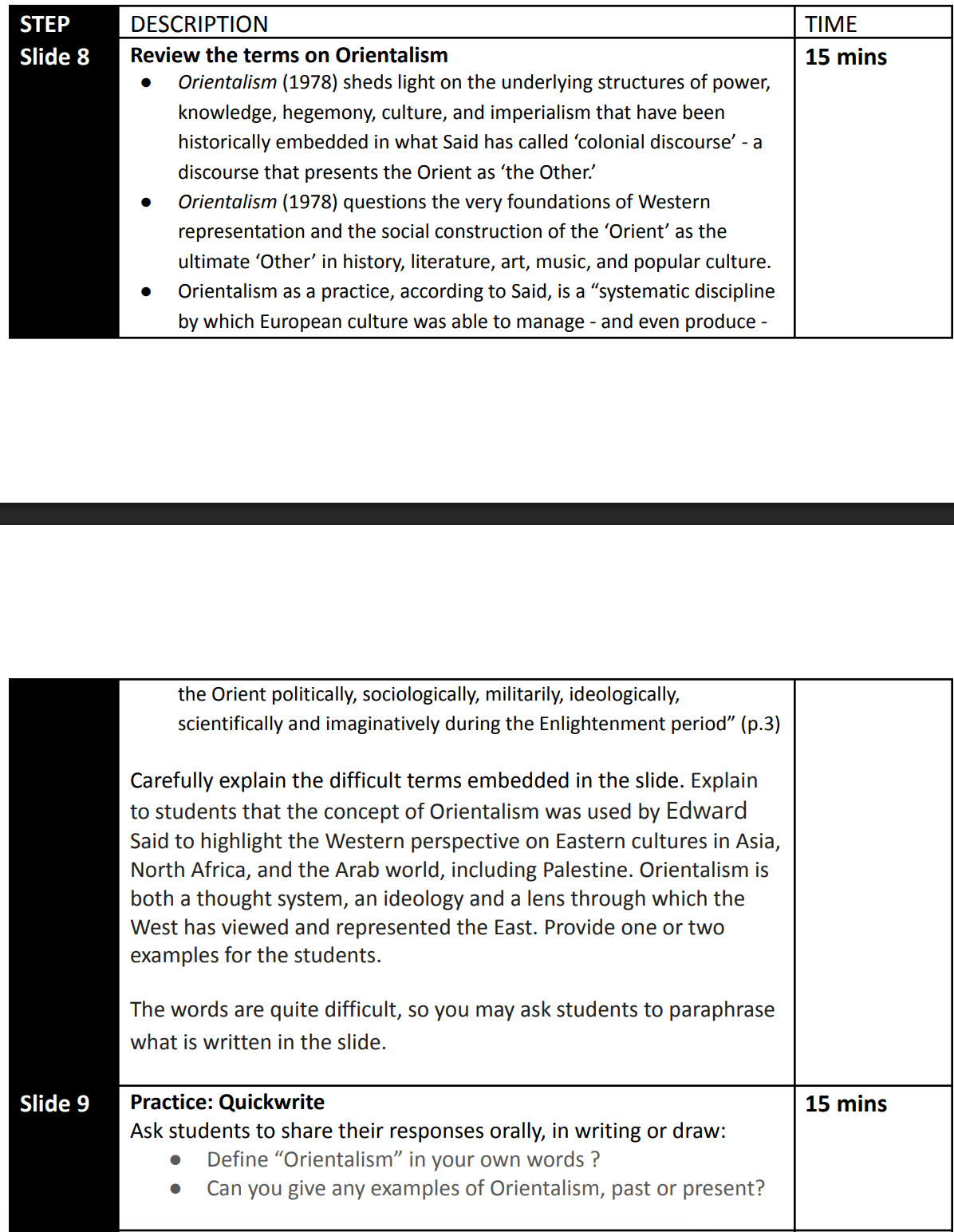
these lessons are supposed to really be about helping students to name these things and then helping them to find whatever it is that is what they were meant to do, what they feel like is their place in the world to take action.
They don’t pretend. They don’t hide the ball. These “lessons” are about presenting a particular worldview and then encouraging students to adopt that worldview and become activists in service to it.
Humanizing Pedagogy and Jewish Supremacy
Throughout the webinar, there were many references to the “humanizing pedagogy” of ethnic studies and social justice-oriented classes. By contrast, the discussion following the presentation of Winograd and Carrasco Cardona’s lessons focused on the danger of Jewish supremacist thinking.
Nile El Wardani, a lecturer in Global Health at the University of California, San Diego, said she would implement the resources shared in the webinar. El Wardani said she is on a committee in the San Diego Unified School District which lobbies the district to incorporate more Arab and Palestinian materials in schools.
She asked:
…This is Jewish land. It has been Jewish land for thousands of years. Okay? How do you counter that narrative, which is the narrative that you hear over and over and over to justify the taking of more land, to justify the killing of Palestinians, to justify more settlements.
Winograd says that the religious argument is just “an excuse for privilege, for the privilege to ethnically cleanse.”
It’s an issue rooted in just supremacist ideology.
Jenin Mahdi, CODEPINK’s Palestine campaigner, said the conflict is not a religious one but “it’s an issue of settle colonialism and really dangerous nationalism, it’s a political issue. It’s an issue rooted in just supremacist ideology.”
so people need to stop looking at it from a religious lens because that’s when things kind of get murky. But whenever you look at it from a straight on, this is occupied land from an occupied power that was given power by imperialist empires like the US and Britain. And it’s wrong. It’s a very easy story to tell.
Carrasco Cardona says that if Jewish people were being dehumanized, having their culture erased or denying their existence (say, for example, Jewish indigenity to the land of Israel and connection to Israel as a core feature of Judaism), she “would be rising in defense. But right now, that’s not the case.” Her claim sits uneasily beside the webinar’s treatment of Jewish indigeneity, Jewish historical attachment to Israel and Jewish concerns about antisemitism.
We have been subjects of a federal lawsuit literally because of the fact that if you really look at the definition of ethnic studies and all of the critical concepts that define ethnic studies, you logically come up with “Palestine is occupied. It’s a settler colonial project, and there is a genocide happening.” And we believe that you should not be murdering people and erasing culture and denying that people exist and dehumanizing. And that goes for all people. But in this instance, we’re specifically talking about Palestinian people and by acknowledging and uplifting and wanting to know more about and do the right thing for our Palestinian relatives, does not in any way, shape or form mean that we hope that on Jewish people, that’s completely false. If it was in a reverse, I would be rising in defense. But right now, that’s not the case. The case is that there is an active genocide against Palestinian people, and that’s in the form of actual murder. And there’s also an ethnicide. There’s also a scholasticide. And I, as a Chicana educator, have felt the wrath of what it feels like to be in solidarity.
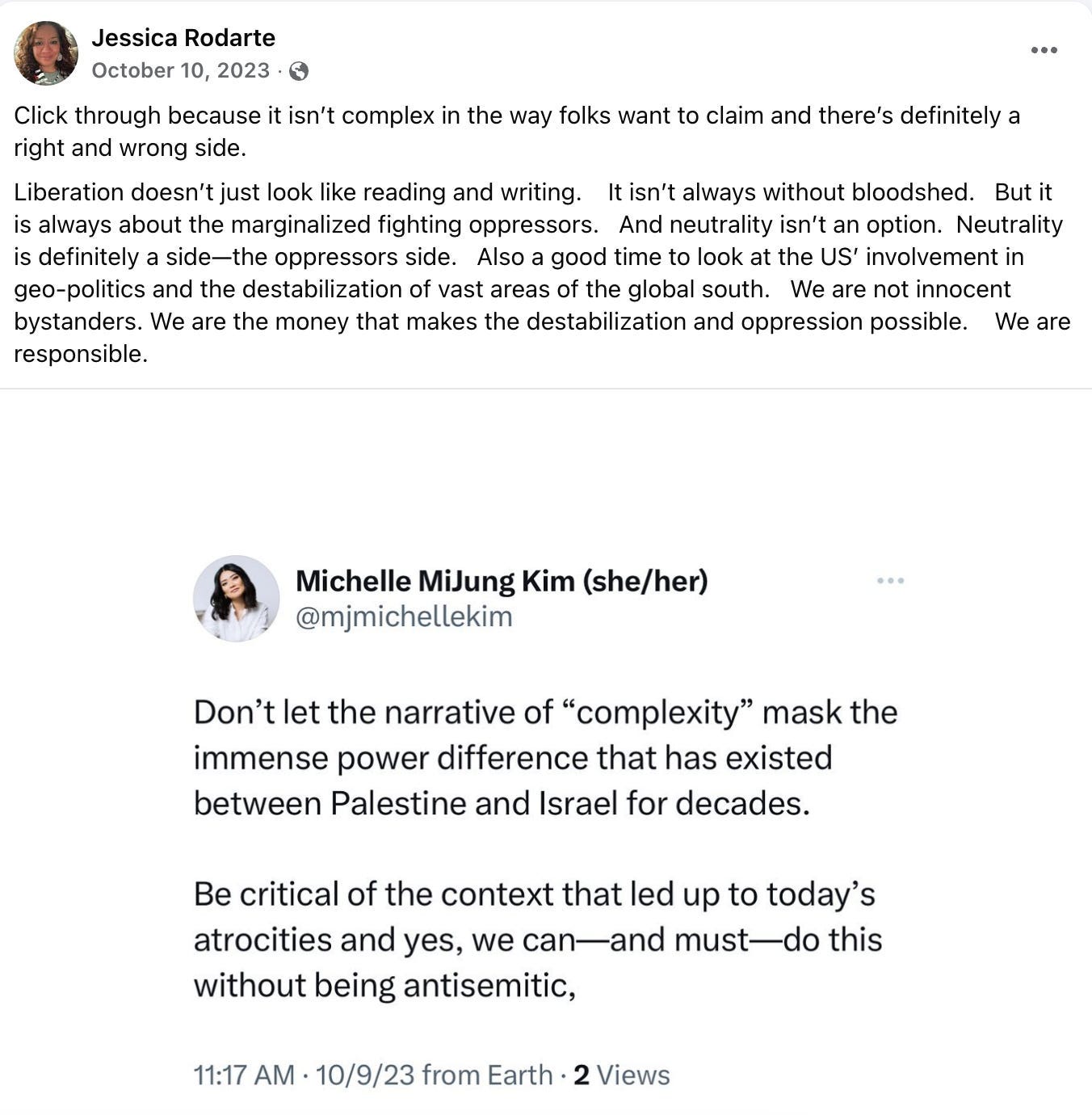
On her public social media, Carrasco Cardona’s response to the greatest single day massacre of Jews since the Holocaust was silence. However, two weeks after October 7, she was posting about genocide. Carrasco Cardona’s close colleague in UTLA, Jessica Rodarte, was clearer in her response to October 7. On October 10, 2023 Rodarte posted the following to her public Facebook account:
“Liberation doesn’t just look like reading and writing. It isn’t always without bloodshed. But it is always about the marginalized fighting oppressors.”
In May, Carrasco Cardona attended a rally against AB715, the law to protect K-12 against antisemitism, alongside her UTLA colleague Ron Gochez.
At that same protest, Gochez appeared to compare teachers who maintain neutrality in the classroom to Nazi Germany.
In a 2002 letter to San Diego State University’s student newspaper, Gochez wrote about the “Jewish-owned media” which “continue[s] to blind the masses with propaganda to keep them in fear.” The title of the letter was “The Agenda Of US Government Is White Power.”
Winograd says that “the Israel lobby is really powerful [in California].” She says that AB715 “conflates criticism of Israel as a Jewish state, a supremacist state, with antisemitism.”
However, the IHRA definition, to which she is referring, explicitly says that criticism of Israel that is comparable to criticism of any other country is not, by itself, antisemitic.
Winograd also appears to have a problem with the fact that Yad Vashem and other Jewish organizations are involved in “a collaborative on Holocaust and genocide education.” She says that the focus of the collaborative is “on teaching teachers how to teach the Holocaust to legitimize the necessity of a Jewish ethno-state and to conflate criticism of Israel with antisemitism.”
She is upset that the collaborative will teach about the 3 D’s of antisemitism: demonization, delegitimization and double standards. All of which have been on display during CODEPINK’s webinar series: only Israel is demonized - the plight of the Palestinians in Lebanon, Jordan, Syria for example, is never spoken about. Egypt’s border wall with Gaza doesn’t warrant a mention. Only Israel is described as a religiously supremacist ethno-state. Of course, Islamic colonialism is never mentioned. Only Jewish trauma is accused of being weaponized for political ends, whereas the “Nakba” does not get such scrutiny.
Carrasco Cardona, meanwhile, speaks about the “chokehold” that the “Israel lobby” has on the California legislature and that ethnic studies activists don’t have the money that pro-Israel activists do.
But at least, Carrasco Cardona says, the “genocide that is happening” has led “more people [to] understand what Zionism is like.”
CODEPINK is an organization currently under investigation for its propaganda trips to Cuba and is linked to Chinese Communist Party ally, billionaire Neville Singham.
It bears repeating that the teachers unions have given these activists a lot of influence.
The AFT allows unvetted lessons by CODEPINK activists like Winograd to be shared with their members and filter into classrooms.
Winograd, a leader within CODEPINK, leads a pro-Palestine caucus within the California Teachers Association.
Carrasco Cardona ran for leadership of the United Teachers of Los Angeles. She lost her bid to be UTLA VP by a whisker - gaining 49.24% of the vote.
Within the CTA, she is part of the Human Rights Department and trains teachers on matters of social justice. She was even awarded CTA’s Human Rights Award in 2022 for her role in developing the Liberated Ethnic Studies Model Curriculum Consortium.
…like they try to say anti-Semitism which is really ridiculous, right, because what they do is they conflate and part of that is by putting the star on their flag