
Inside a Rethinking Schools “Teaching Palestine” Study Group

The K-12 Extremism Tracker has obtained screenshots and verified transcripts of a “Teaching Palestine” study group run by Rethinking Schools’ Adam Sanchez and Susanna Kassouf for an institution called the Sojourner Truth School For Social Change Leadership.
While this study group was not geared exclusively to educators, it provides good insight into how Rethinking Schools’ Teaching Palestine is used in both teacher training workshops and in the classroom with K-12 students.
At the end of the final workshop, Sanchez mentions that Rethinking Schools is working on a new volume of “Teaching Palestine” which will focus on Palestinian “resistance.”
The workshop covered three sessions - a truncated version of the summer reading study groups run in cities like Philadelphia. This workshop covered “Seeds of Violence”, Israel and US relations, and Israel’s “Apartheid”.
Teaching Palestine Workshop 1: Teaching the Seeds of Violence
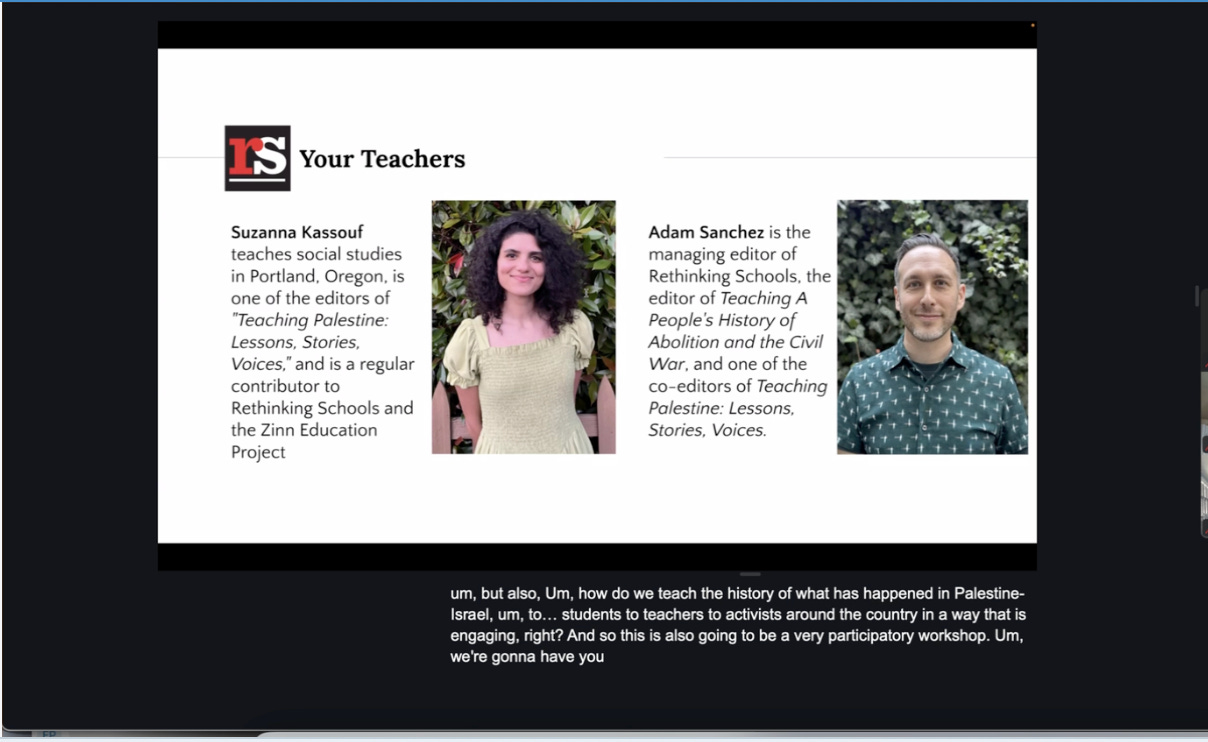

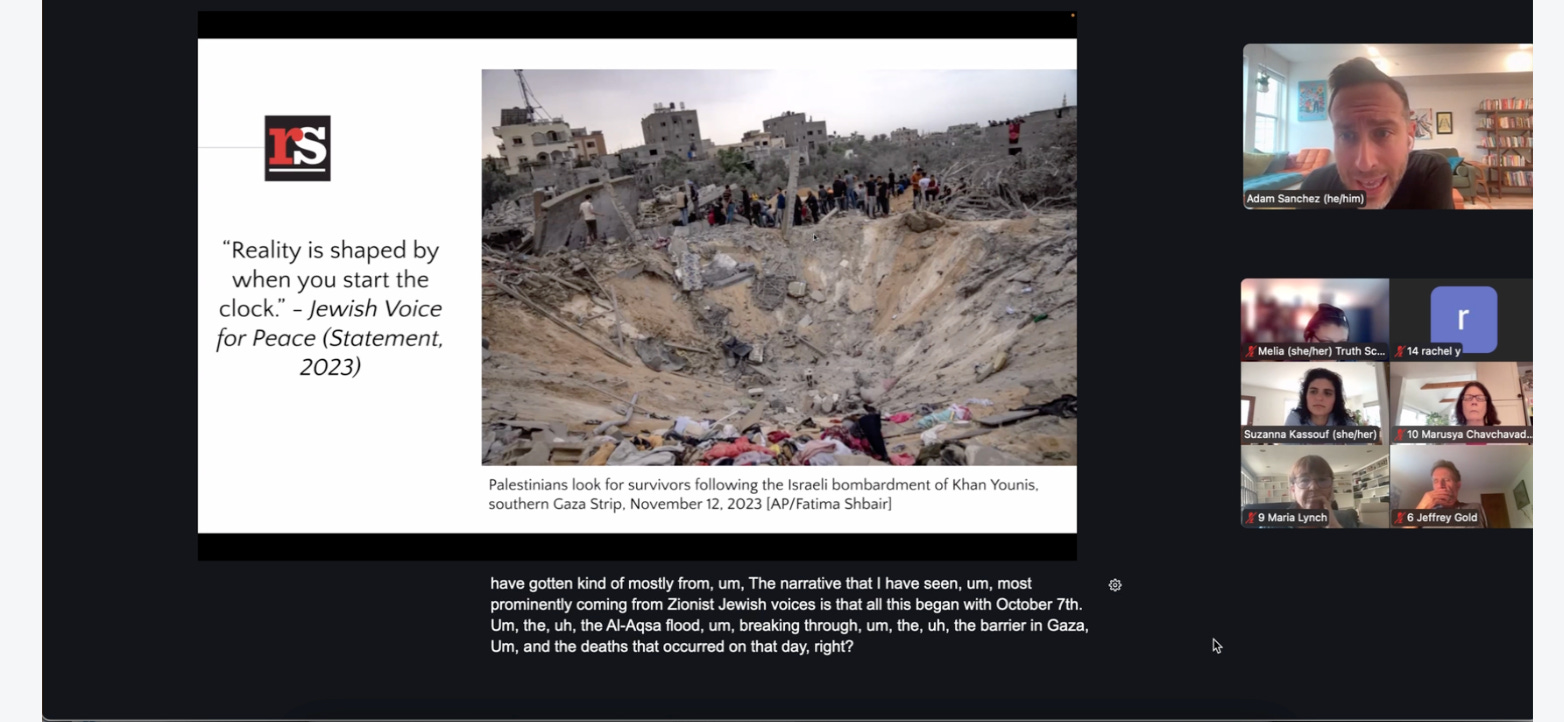
The workshop begins with an introduction by Sanchez and Kassouf. Sanchez discusses the “livestreamed genocide” which motivates these workshops. In his opening remarks, Sanchez says that “Zionist Jewish voices” say that “all this began with October 7th, the Al Aqsa Flood, breaking through the barrier in Gaza and the deaths that occurred on that day. And that is a narrative that really has taken hold in western media. 1200 were killed that day, 251 hostages. That is the emphasis of where to begin the clock. And we really wanted to start with this Jewish Voice for Peace statement that talks about how reality is shaped by when you start the clock.”
Kassouf talks about using the lessons from “Teaching Palestine” in her 9th grade social studies class:
So we’re going to be doing this lesson by my, I’m honored to say, my mentor and friend Bill Bigelow. Actually, he tested this lesson in my ninth grade social studies classroom in early 2024 in January. So yeah, like Adam said, reality is shaped by when you start the clock. So if you start the clock on October 7th, 2023, you’re going to have a very different story than if you go back further in time. One thing Bill did when he came into my classroom was he brought a rubber bullet and he actually drops the rubber bullet on the table. I don’t know if you’ve ever seen a rubber bullet before. I hadn’t. It makes this sound like a hard metal thump. It’s very intense. And he collected that bullet when he was in Gaza in 1989, the year that I was born.
And during that time, the IDF was shooting into schools and he collected that bullet from a school that a child brought to him. But we’re not going to even start back in 1989. We’re going to zoom all the way back to the birth of Zionism.
Adam Sanchez:
I’m Adam Sanchez. I’m the managing editor at Rethinking Schools. And the main reason I’m here is because I co-edited this with Susie, this book that we’re going to be drawing a lot of materials from for this workshop. Susie and I normally are used to working with educators and high schoolers mostly. I was in the classroom for over a decade. And so we’re going to talk to you both in the sense of whether you want to, if you’re coming here, to be a student, to be a learner, but also if you’re coming here as an activist or an educator who wants to help others learn because that’s what this book is really about, is about not just how do we grapple with what has happened over the last two years, which I think is a big reason a lot of us are here, which maybe I’ll talk about in a bit, but also how do we teach the history of what has happened in Palestine- Israel to students, to teachers, to activists around the country in a way that is engaging, right?
So I’ll just start by saying a few words about what I think brings us here today is the two years of livestreamed genocide that we have witnessed in Gaza. And for me as someone who grew up in a Zionist Jewish household and had to kind of relearn a lot of the history and myths that I had been taught as a young child, the last two years has been particularly striking both in just the brutality that I’ve witnessed taking place, but also, I mean, we could go on with statistics that the 95% of schools in Gaza that have been destroyed, the hospitals, the immense amount of casualties, the starvation of the last year.
This is something, obviously there’s a huge history to this that we need to delve into that is contested, but it’s also something that I think over the last two years has just been incredibly shocking and transformational in terms of Jewish public opinion, in terms of liberal public opinion in this country and on and on. It has really reshaped the political map, I think, in ways that we’ve only begun to see with the election of, the coming election, I’ll be optimistic, of Zohran Mamdani in New York City, and we’ve only begun to really see how the sea change in public opinion has really taken hold. And of course, a few weeks ago, maybe even rece..more recently that it feels like that long ago that there was a ceasefire announced, right? But I think what’s become clear is that the cessation of hostilities, which hasn’t really happened, there’s been some more aid let in and some reprieve for sure, which deserves to be celebrated, but there is still killings of Palestinians. There are still many, many things to be, that are still unjust, right? Even if we had a bolder ceasefire as well as the violations of the ceasefire that have continued to happen. And so really the narrative that I have gotten, mostly from the narrative that I have seen most prominently coming from Zionist Jewish voices, is that all this began with October 7th, the Al Aqsa Flood, breaking through the barrier in Gaza and the deaths that occurred on that day.
And that is a narrative that really has taken hold in western media. 1200 were killed that day, 251 hostages. That is the emphasis of where to begin the clock. And we really wanted to start with this Jewish Voice for Peace statement that talks about how reality is shaped by when you start the clock. And so we, I’m going to hand it over to Susie, and we’re going to engage in one of the first, and I would say key lessons in this book. If I, as an educator, as an activist, want to build a curriculum for fellow activists or my students around Palestine, I would probably start with this lesson, which brings the clock much further back than October 7th, and I’ll let Susie take it from here.
Suzanna Kassouf:
So we’re going to be doing this lesson by my, I’m honored to say, my mentor and friend Bill Bigelow. Actually, he tested this lesson in my ninth grade social studies classroom in early 2024 in January. So yeah, like Adam said, reality is shaped by when you start the clock. So if you start the clock on October 7th, 2023, you’re going to have a very different story than if you go back further in time. One thing Bill did when he came into my classroom was he brought a rubber bullet and he actually drops the rubber bullet on the table. I don’t know if you’ve ever seen a rubber bullet before. I hadn’t. It makes this sound like a hard metal thump. It’s very intense. And he collected that bullet when he was in Gaza in 1989, the year that I was born.
And during that time, the IDF was shooting into schools and he collected that bullet from a school that a child brought to him. But we’re not going to even start back in 1989. We’re going to zoom all the way back to the birth of Zionism.
We’re going to be doing a super condensed version of this lesson. When I did this version in my classroom, it took five 90 minute classes.
The lesson can be accessed on the Zinn Education Project website. The workshop then went into “breakout sessions” where participants were given characters to role play and a set of questions to ask.
In the mixer, students “become” individuals to bring this history, and more, to life. Note that they do not act anything out. They try to internalize their roles to represent to one another their characters’ experiences, opinions, and aspirations. There are 17 of them. Here is a summary. The Zionists and pro-Zionists include: Theodor Herzl, Viennese “founding father” and theoretician of Zionism; Arthur Ruppin, director of the Palestine office of the Zionist Organization, and a purchaser of land for Zionist settlement in Palestine; Joseph Baratz, Zionist settler, who fled pogroms in Russia as a teenager as part of the Second Aliyah (migration) of Jews to Palestine, and worked there in one of the first kibbutzim; Lord Arthur Balfour, the British foreign secretary, who issued the fateful Balfour Declaration, announcing British Empire support for a Jewish homeland in Palestine; President Woodrow Wilson, supporter of the Balfour Declaration and the Zionist movement; and Herbert Louis Samuel, British High Commissioner for Palestine during the early years of the British Mandate period. Two Jews in the mixer are anti-Zionists: the Sephardic Jew, Yosef Castel, whose family had lived in harmony with Arab Christians and Muslims in Palestine since Jews were expelled from Spain in 1492; and Pati Kremer, a member of the socialist Jewish Bund, which sought to transform rather than flee eastern Europe, and saw Zionism as divisive and numb to the exploitation of working-class Jews by capitalist Jews.
Three roles are Palestinian peasants: Ahmed Sharabi, evicted from his land by Zionists of the First Aliyah (migration from Europe), who bought Sharabi’s land from an absentee landlord; Mahmoud Khatib resisted his land being taken over by Zionists of the Second Aliyah, who also had bought it from a wealthy landlord in Beirut; and Razan al-Barawi who lived in Gaza and was caught between warring empires, the Ottoman and British, made a refugee and reduced to dire poverty. Shukri al-‘Asali, the Ottoman (and Palestinian) district governor of Nazareth, refused to approve the Zionist purchase of land from absentee landlords that would result in peasant evictions.
Scholars and journalists wrote defiantly about the waves of Zionist migration and the Zionists’ separatist vision for Palestine, which would turn Palestinians into “strangers in their own land”: Palestinian scholar Yusuf Diya al-Din Pasha al-Khalidi knew Theodor Herzl from his time in Vienna and wrote to him: “In the name of God, let Palestine be left alone”; Najib Nassar, the Christian publisher of the newspaper al-Karmil, wrote about Zionist land purchases and Palestinian expulsions; ‘Isa-al-‘Isa, editor of Filastin, wrote critically about the Balfour Declaration and the British-Zionist partnership during the early years of the British Mandate; and Musa Kazim al-Husayni, a leader with the Palestine Arab Congress organized against the discriminatory nature of the British Mandate in the years after the Great War. And finally, there is Elias Sursuq, one of a number of absentee landlords who took advantage of an 1858 Ottoman law to claim ownership of huge tracts of land in Palestine and later sold that land to Zionists, who were committed to empty the land of Palestinians.
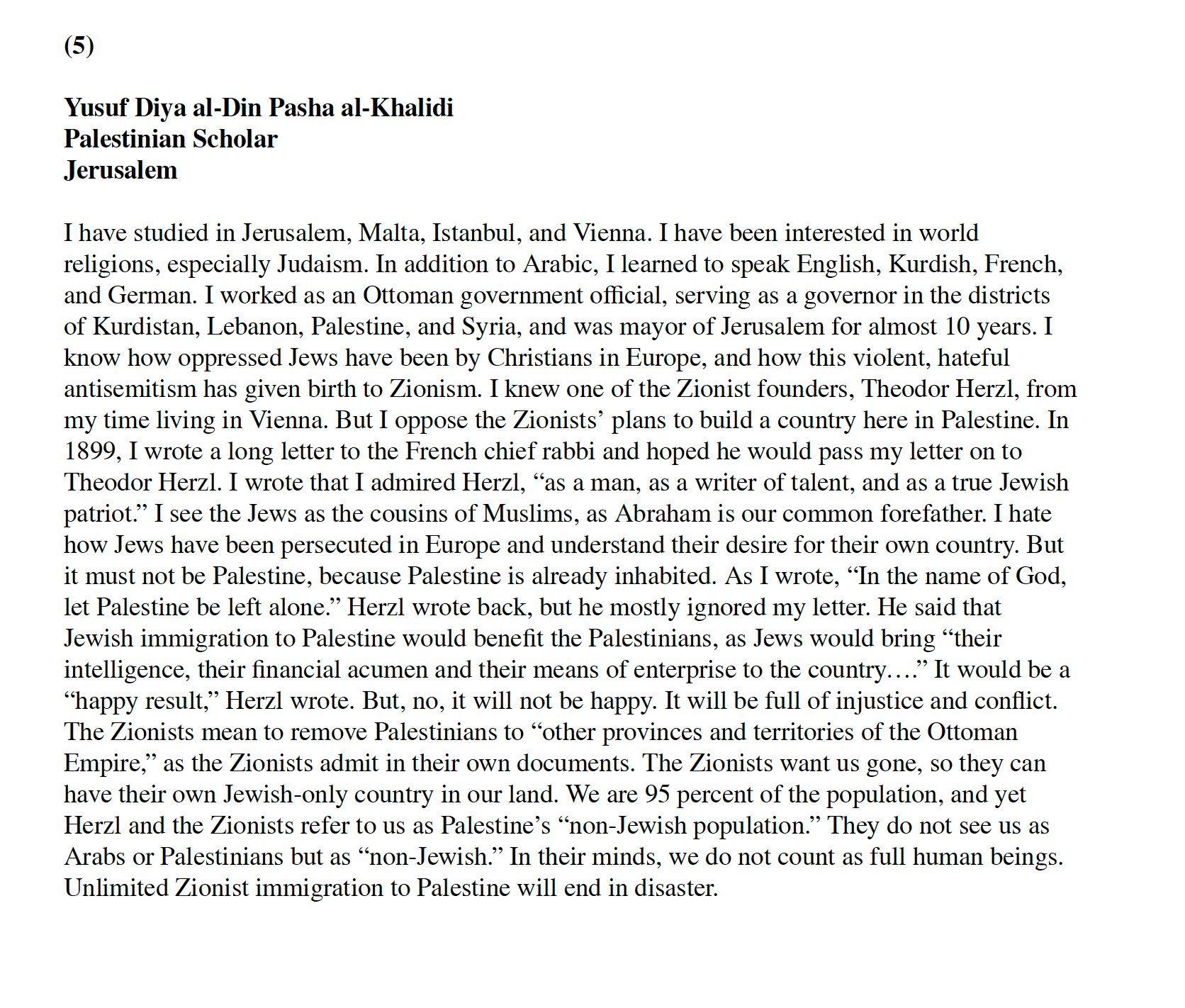
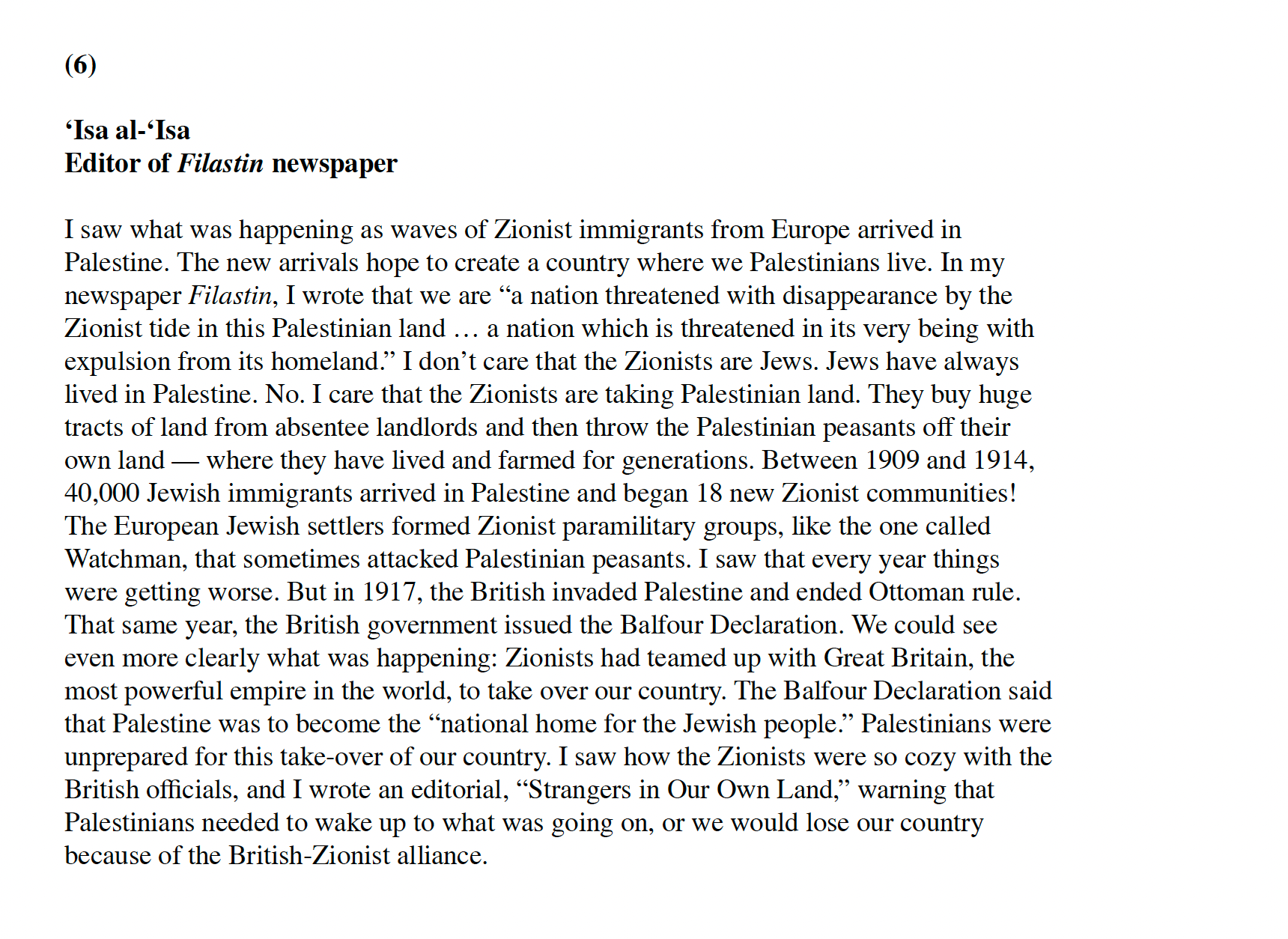

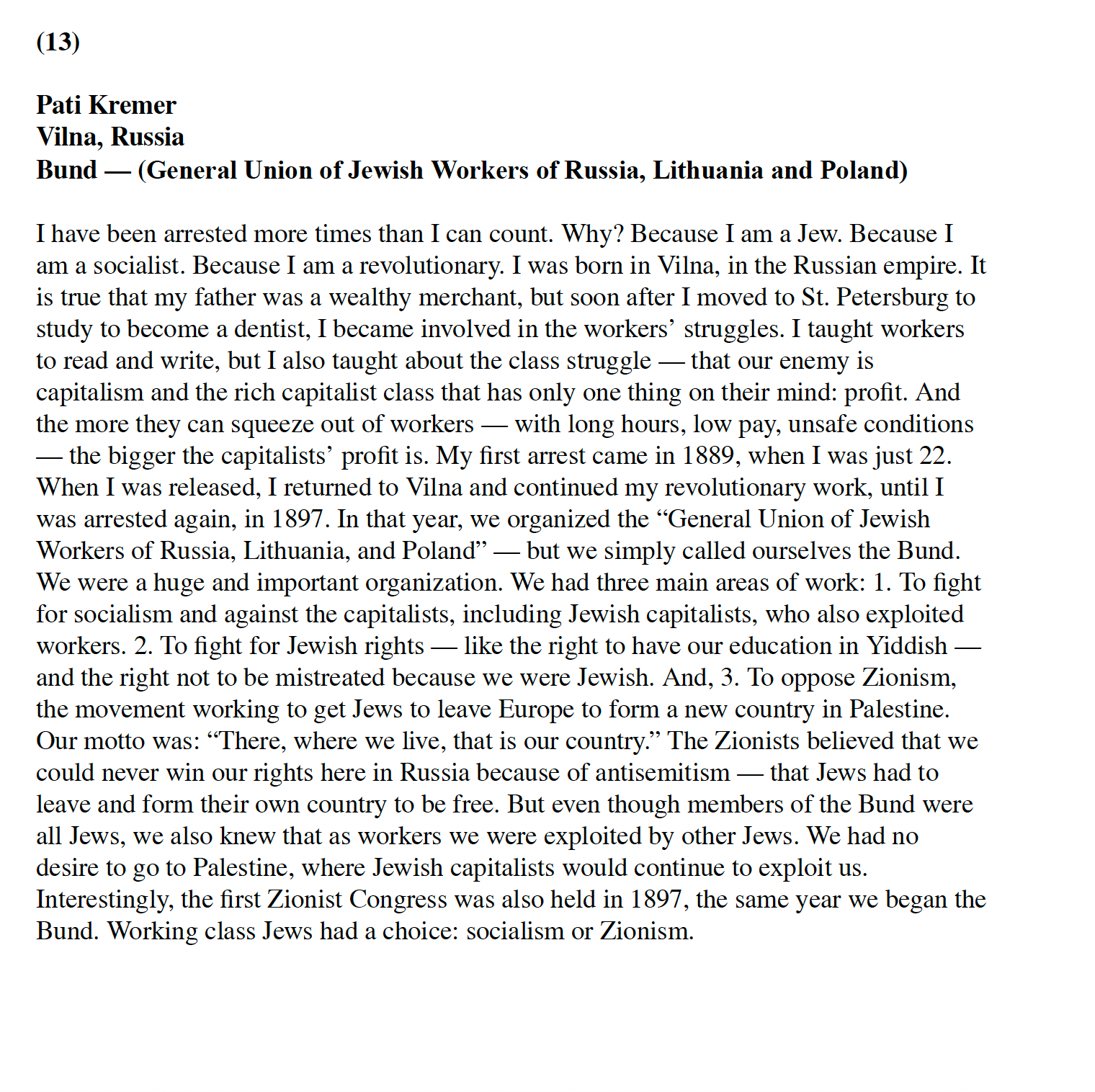

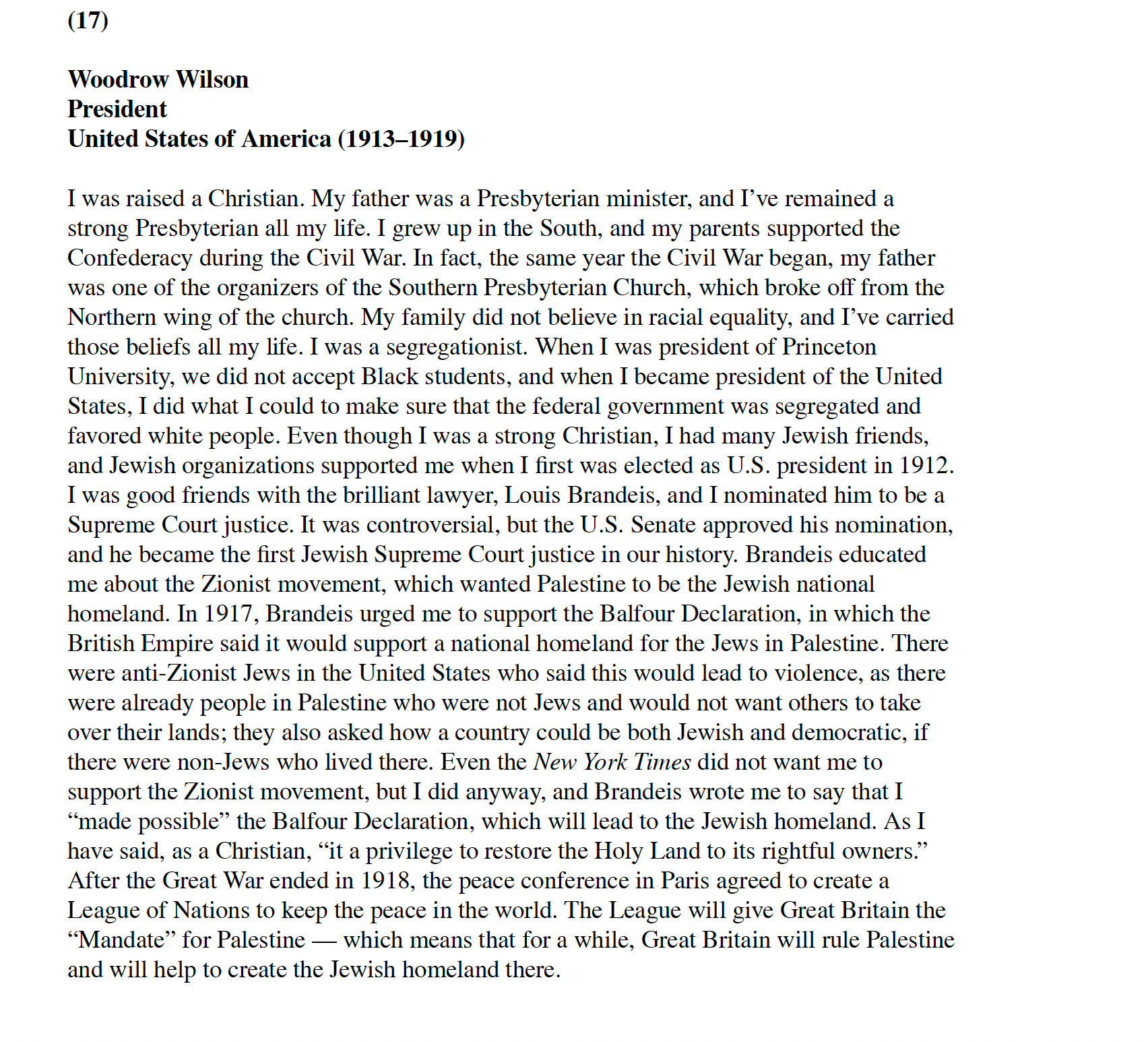
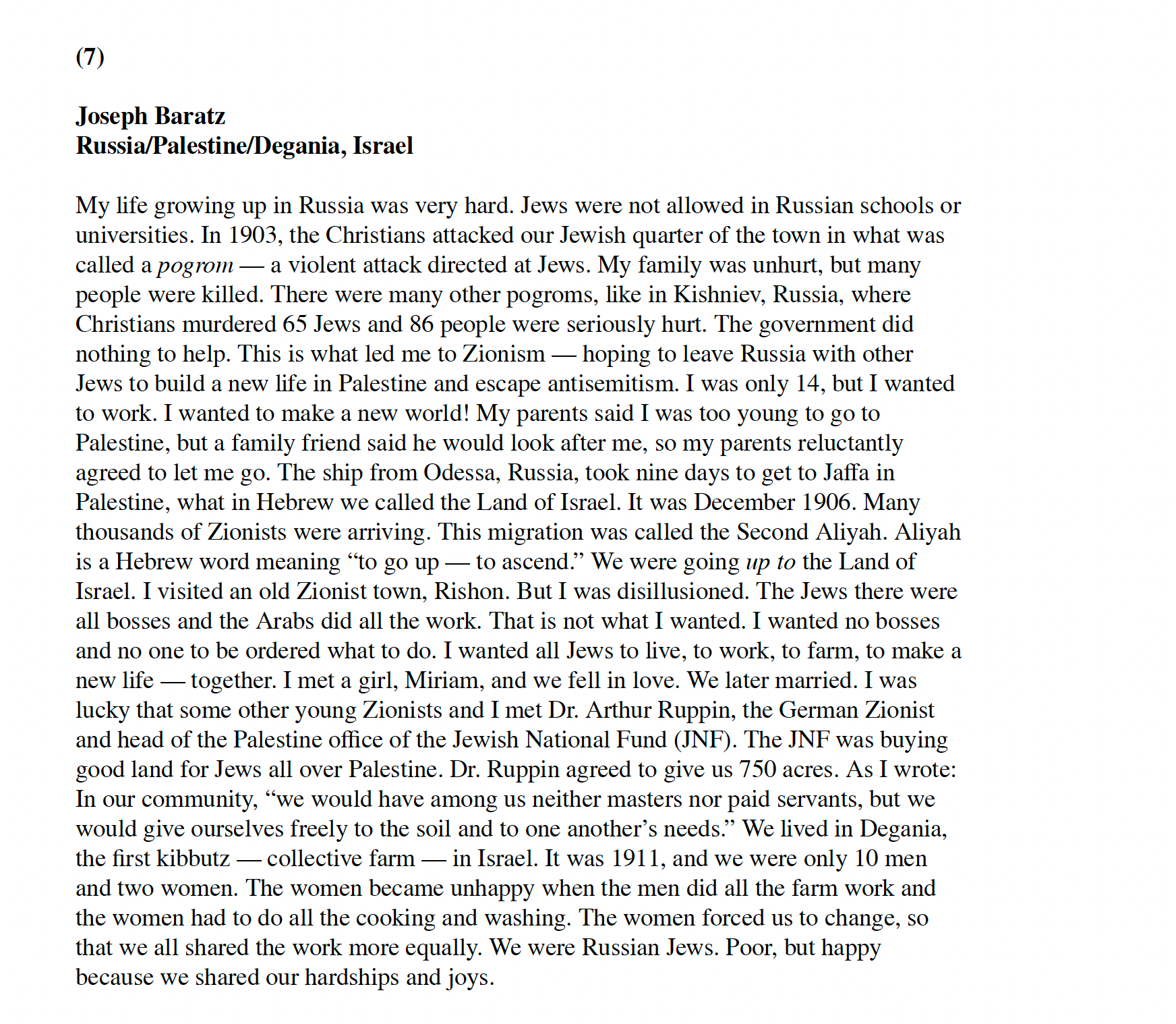
While the lesson claims to present Zionist voices and the Zionist narrative, it is clear that the characters and depictions presented to students are supposed to lead them to a particular conclusion - that Muslims, Christians and Jews had been living together peacefully and without issue until the Zionists (read: Capitalist Jews) arrived. Violence by Arabs is framed as “defensive” and just.
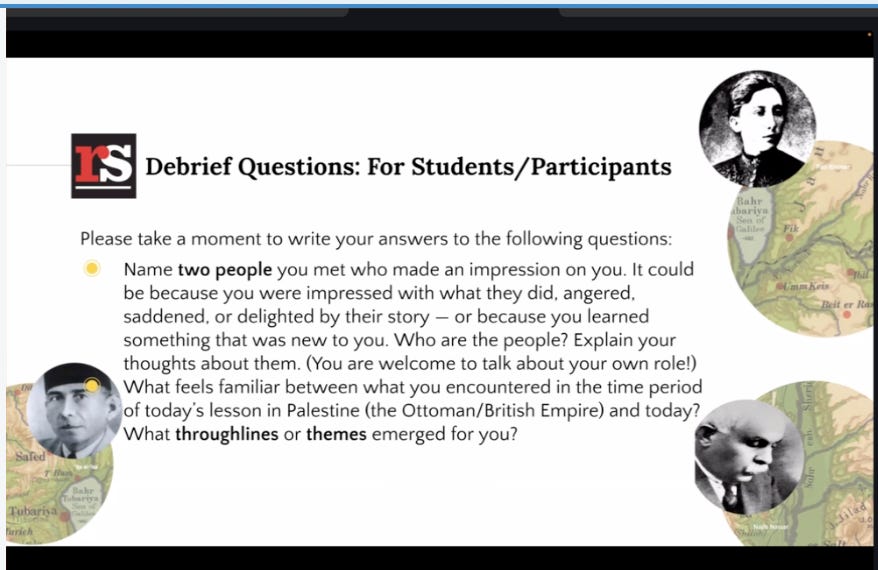
In the debrief session, Kassouf has this to say:
So the first thing you said about this, the power indifference, we’re seeing that there’s been this kind of partnership with Empire throughout this whole time. So Zionists, they start with this kind of partnership with Empire, with the Ottoman Empire, with that land code. Like exactly what you said. That Ottoman Land code allowed all these absentee landlords to own huge swaths of land in Palestine, and then they sold them to the Zionist organizations in many cases. It wasn’t necessarily like a stealing of the land, it was the buying of it. And I think for those of us who’ve learned about gentrification, we can understand how even when you go about these legal routes, there can still be major injustices happening, like all these Palestinians being evicted. Then of course we see the partnership with the British Empire, with the Balfour Declaration, et cetera. Then today, partnership with the American Empire, right?
…We see the people who are defending their land being framed as the ones who are violent and the people who are taking the land, being framed as the ones who are defending themselves somehow. Right? Yeah. Thank you so much for sharing that. And I think it’s so important what you mentioned that for many of the Palestinian roles, they’re not necessarily just threatened by Jewish immigration because Jews and Christians and Muslims had been living in relative harmony for centuries in this land. But rather, I think the Arthur Ruppin rule really points it out that this wasn’t about just immigrating to the land. This was about creating a Jewish country that is by, for, Jews and only Jews, which necessitates a massive exiting of the Palestinians who’d been living there the whole time. Yes, thank you. Anybody else can come off and share what you wrote about. We would really appreciate to hear from at least one more person.
And I think this is such a key important point that antisemitism is at the core of why many people support Zionism at this time. With your example of Lord Balfour, it was not just a way for, yes, of course, Great Britain wanted to have a little, basically a post in the Middle East to protect their trade routes and all these things, but they also wanted the Jews to leave their country to get out of there and go over there. So we act today, we hear all this rhetoric about how it’s antisemitic to oppose Zionism. When you really look at the history of Zionism, we see that it was antisemitism that was actually fueling Zionism in the first place. And I think we can see it fueling it today as well. Thank you everybody. Thank you for the brave souls, especially who shared out, sorry that I keep having to go through all these different things.
Kassouf ends the session by showing posters created by her 9th grade students, with whom she has used the “Seeds of Violence” lesson:
So we are going to be wrapping up for just today. I’ll show you that in my class. What we did is after we did this role play, students met in groups and they kind of decided who would you say is like who or what is at the core of all the violence we’re seeing today? And then they made posters. And here’s some of the posters, like some students said, antisemitism, some said Zionism, Lord Balfour, some said the Ottoman Empire, some said the British Empire, some said racism against Palestinians, or the belief that we can’t coexist peacefully. All these different things being at the core of what we see today.

Teaching Palestine Workshop 2 : US/Israel Relations
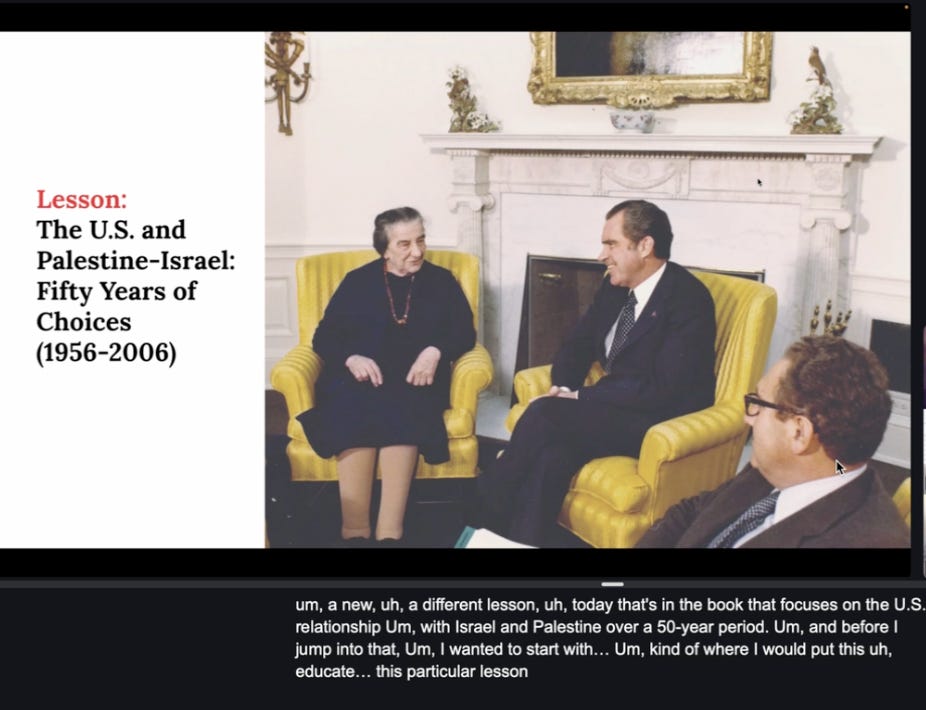
This lesson was written by Adam Sanchez. Introducing the lesson in “Teaching Palestine”, Sanchez writes about the responses of some his students when he taught the class at a high school in Philadelphia. After the lesson, his students understood the “frustrations” that led to Hamas’ October 7 massacre:

Sanchez introduces the lesson to the workshop:
And so I wanted to create a lesson that would take students from post 1948 to relatively recently, like past the Oslo process and to this ends with the kind of rise of Hamas and Hamas winning the elections in Gaza in the early 2000s. And the US reaction to that. So part of the reason I created this was to kind of span a large portion of history in a relatively short amount of time. The other reason was because we really wanted a lesson on the US’ role in all of this, right?
All of us are teachers inside the United States, and the United States has been deeply complicit in Israel.. for ..in Israel’s actions for decades.
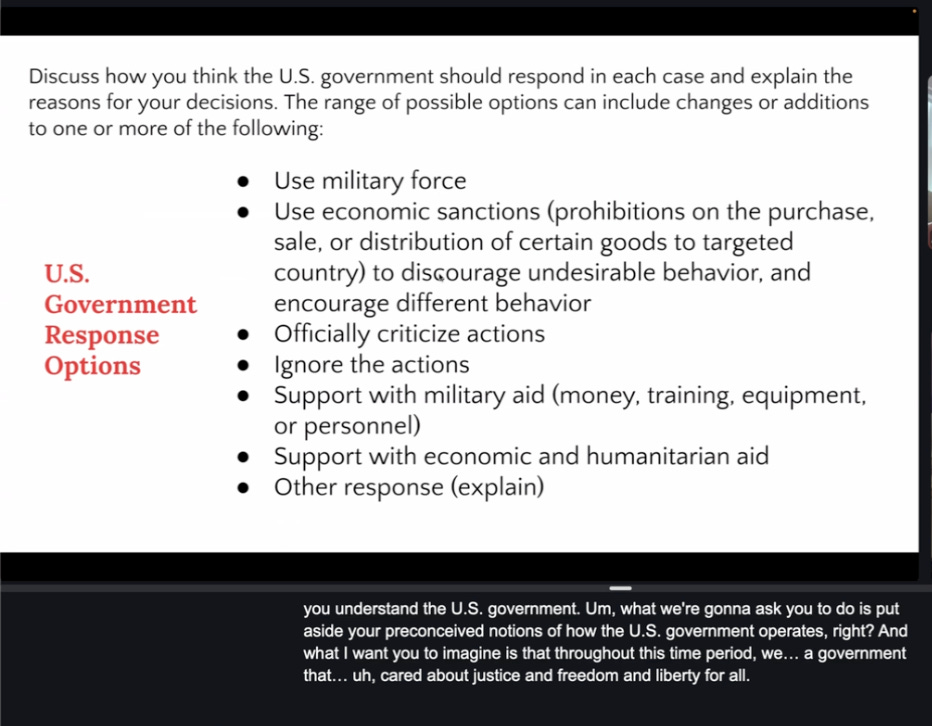
What we’re going to ask you to do is put aside your preconceived notions of how the US government operates. And what I want you to imagine is that throughout this time period, we a government that cared about justice and freedom and liberty for all, right, what we say we care about, but that we actually did. And so what I want you to do is, what I’m going to give you is in your groups, you’re going to look at different scenarios that happen over this time period in Palestine, Israel, and you’re going to have to imagine if the US government is a government that cares about justice, liberty, equality for everyone, how would it respond in this moment?
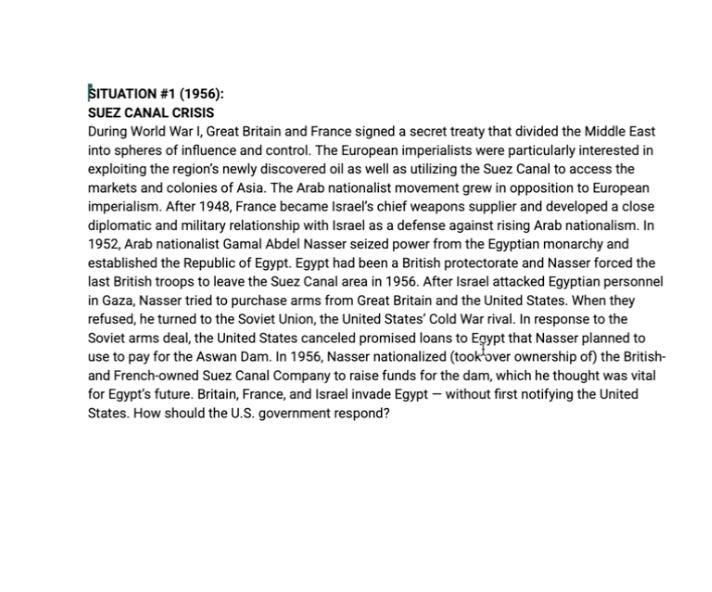
Responding to a question about why Israel attacked Egyptian troops, Sanchez says:
Well, Israel, at the time, there were Palestinian like resistance fighters in Gaza who would sometimes attack Israeli troops. And so they did not like that. Egypt had this territory control that was so close to Israel and had a lot of Palestinians who were frustrated with Israel’s expulsion and trying to resist their expulsion from the rest of Israel.


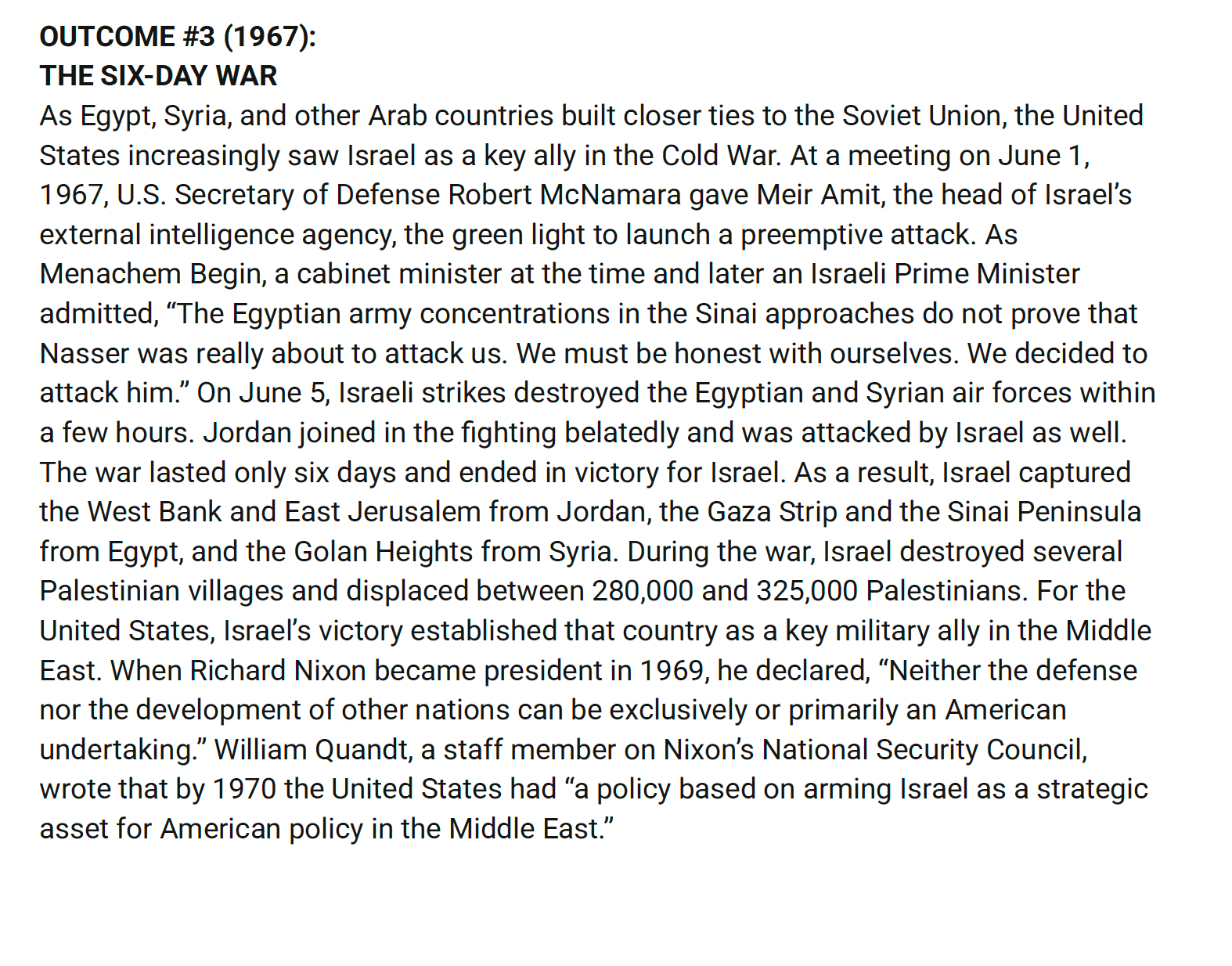
Sanchez:
…And this is very different from how it was covered in the US media, and I think that’s a really important point to understand that in the US media, it was covered like this David and Goliath story, all these Arab countries are attacking Israel, and Israel is defending itself. And so the Jewish community really closed ranked in this moment. And you had, before this, you had a much larger non Zionist, anti-Zionist liberal Jewish community that then moved in line with the more hardcore Zionists in the Anti-Defamation League and other organizations like that. Partially because of the way the Western media portrayed this, it did not let the US intelligence reports or the Israeli intelligence reports, those were not public knowledge at this point… And you can see this in the slides that right after we again begin to ramp up our military aid to Israel right after the 1967 war, and this continues throughout the 1970s.
So if we go to the next slide, you’ll see the situation, the next situation that happens in the seventies, right? We’re way up by 1975, 1976. There’s an asterisk there because that is when Israel becomes the largest recipient of US foreign aid and US military aid. This is the year after the United Nations passes a resolution in 1975, condemning Zionism as racism. So a lot of the colonial world is in this moment, taking an anti-colonial stance and tying that to Zionism and racism, and the United States is doubling down on its support for Israel.
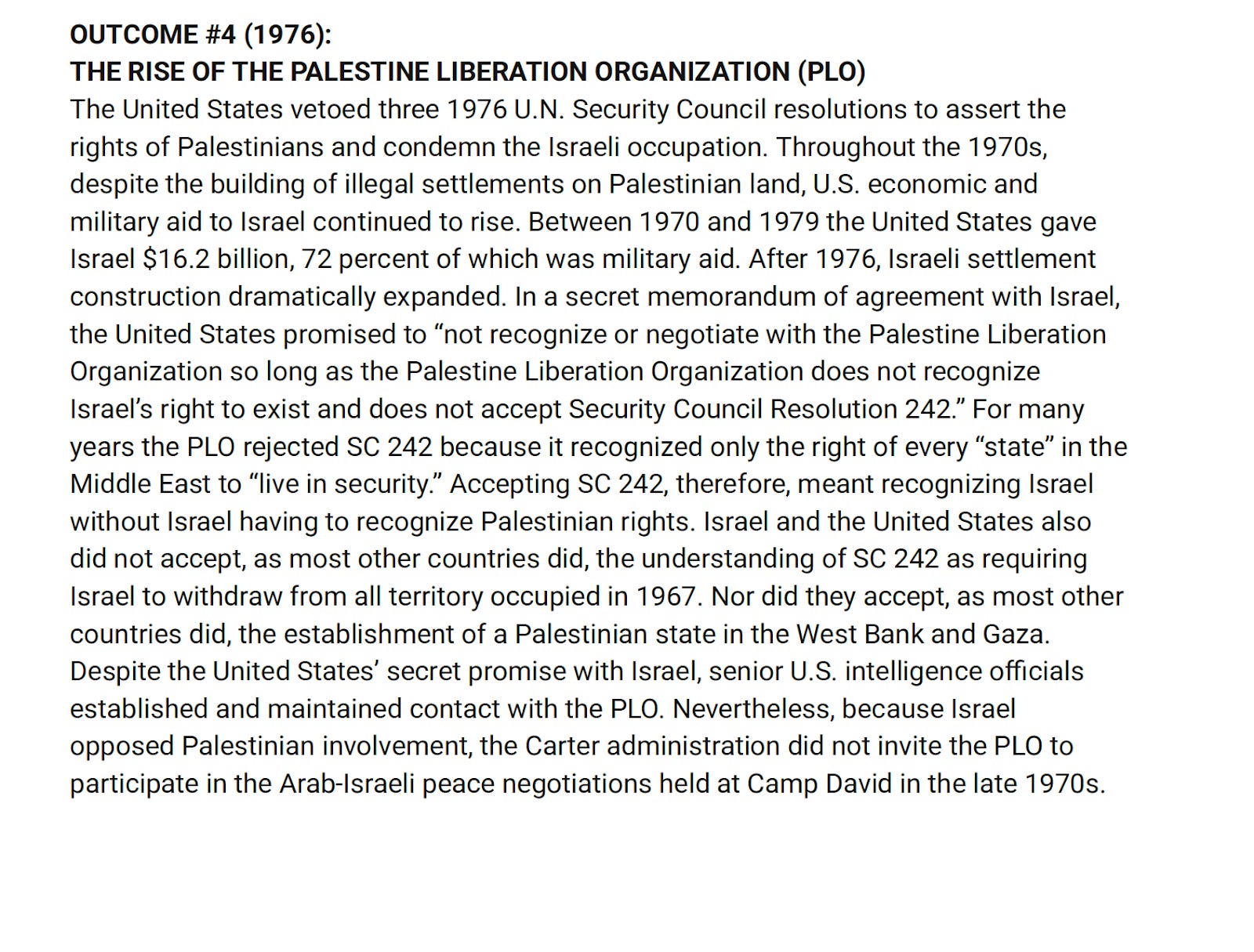
Sanchez:
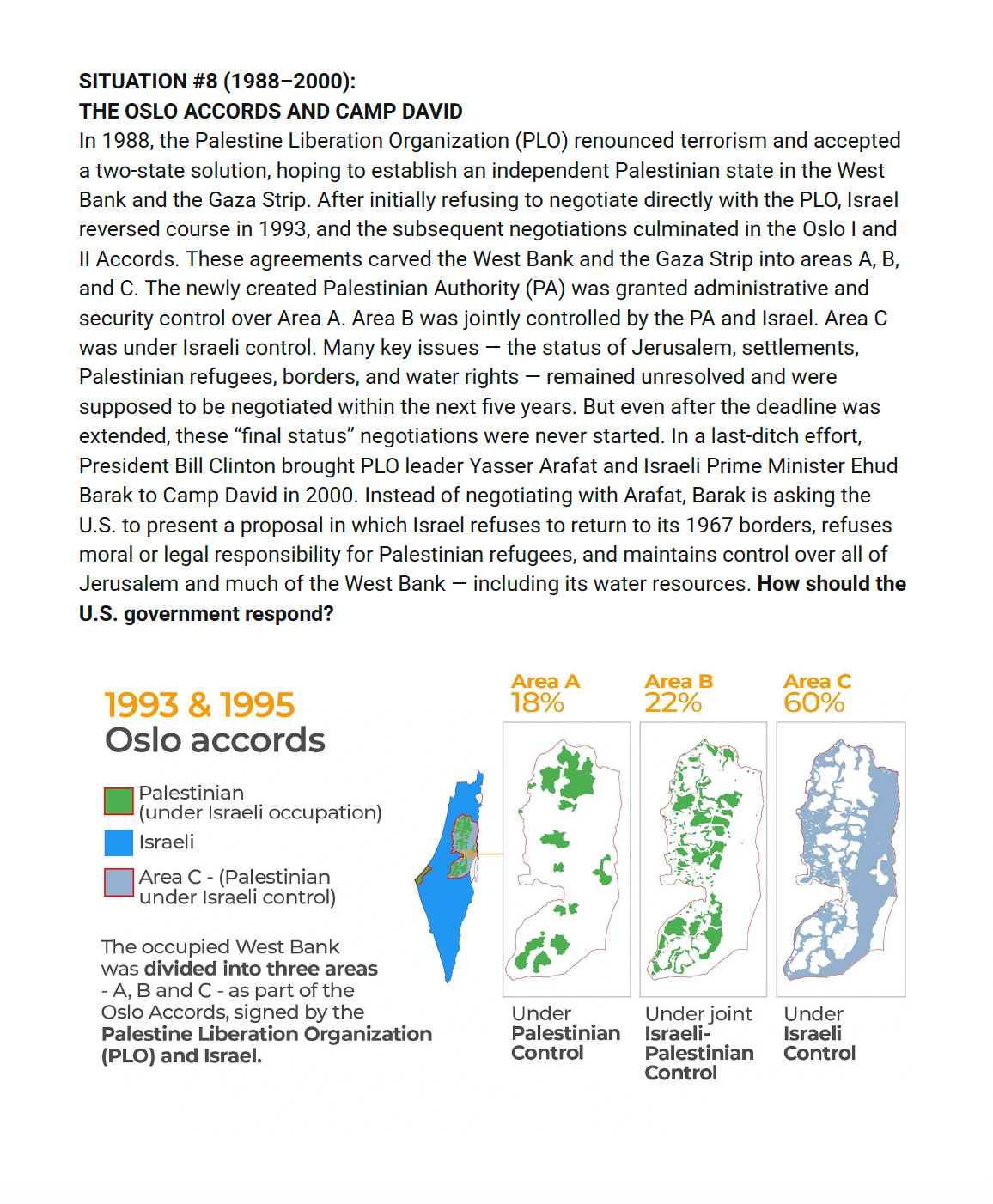
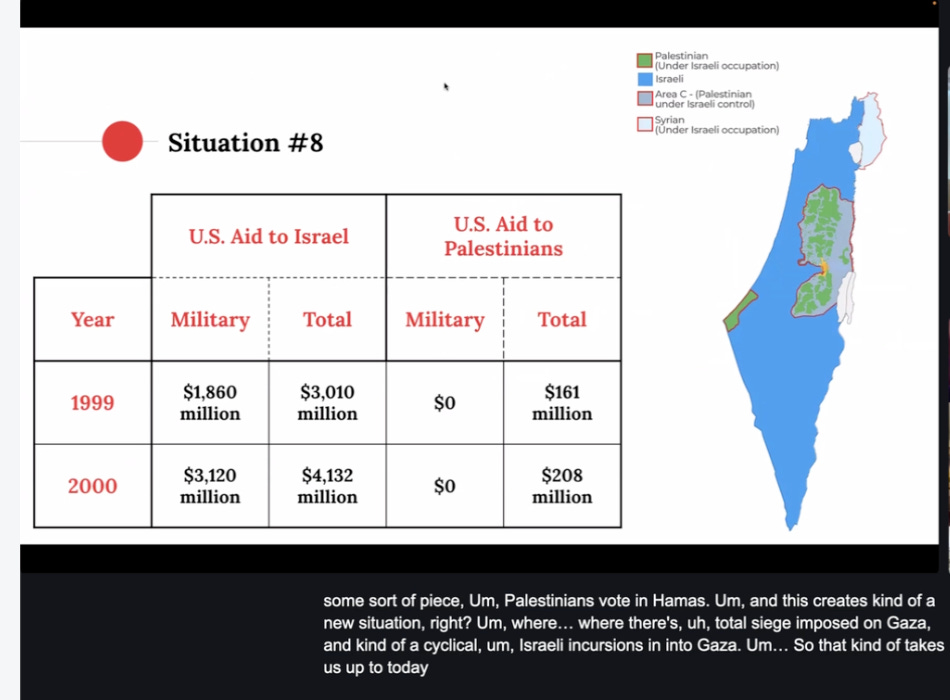
For the sake of time, what I’m going to do is I’m going to skip us ahead. I mean, the response, I think I’ll just say briefly in situation number seven is somewhat interesting because you actually have the Reagan administration issuing a public condemnation for Israel, Israel’s harsh security measures and excessive use of live ammunition. You also have George H W Bush’s even firmer stance with Israel. He delayed 10 billion in loan guarantees, of course, compared to the millions and millions of dollars we’re still giving Israel in military aid. These are relatively minor things that Reagan and George HW Bush did. But I think it shows that even in the eighties in the nineties, there is still, even though Israel has of course become a key ally in the United States, there is still somewhat of a willingness to try and play both sides for the American public. This begins to change with Oslo, but really drastically changes when the US launches the war on terror in 2001 and begins to see the United States and Israel both as these victims of Islamic terrorism and that the Palestinians are, because of Palestinian racism, are kind of seen in the US and Israel as part of this, the Islamic terror. But we’re going to jump ahead to the Oslo Accords and Camp David, because I think this is really the another key moment to understand where we’re at today.
And it ties to this kind of question…that didn’t Israel suggest peace plans for Palestinian state a number of times. And Oslo was really the closest that Israel came to accepting some form of what you would call Palestinian state. I don’t know that I would call it actually a state.
…And that really is the major change, the only major change we see until 2006, where largely I would argue in response to the disgust that many Palestinians have for what comes out of Oslo, and that being kind of sold to them as some sort of peace, Palestinians vote in Hamas. And this creates a new situation where
there’s a total siege imposed on Gaza and cyclical Israeli incursions into Gaza. So that kind of takes us up to today.
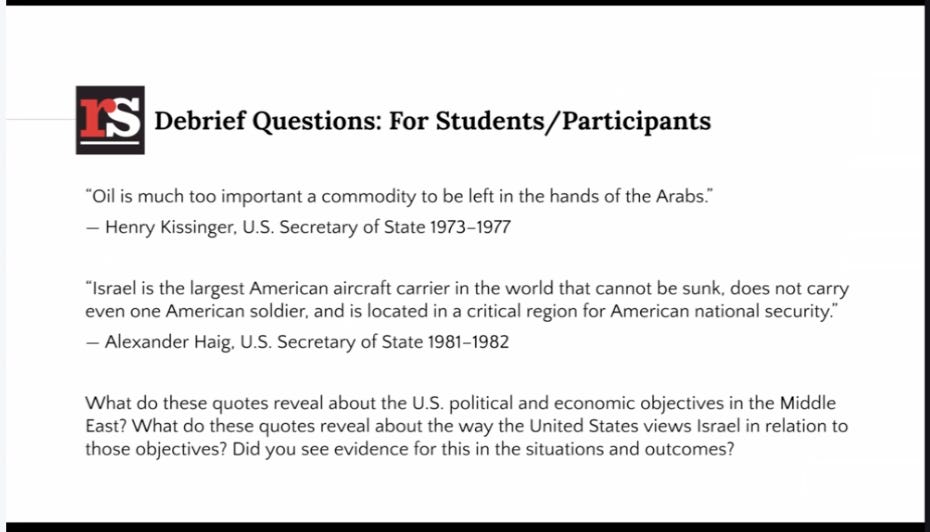
Participants in the second workshop concluded, uniformly, that Israel was the aggressor in each of the examples under discussion.
Participants made statements including that US and Israeli policy was driven by racism, that AIPAC and Israel “thoroughly propagandize every single person in our government” and that “ technology that comes out of Israel, we support them because in a way, the things that we want to use to do all of the bad things that we do as a country start in Israel, the development of so many things can happen away from American eyes in a way that people are just completely unaware of what’s happening and the agreements and the things that are coming out of it. It’s really just even like the Amazon, the drones, all of these things that people have said for a while, they practice on Palestinians and then they bring it here to us. All of these things that are used to control the masses, very often, a lot of technological stuff is coming out of Israel.”
Neither Sanchez nor Kassouf appeared to push back on those statements.
Teaching Palestine Workshop 3: Israeli “Apartheid”
This last workshop focused on Israeli “apartheid.”
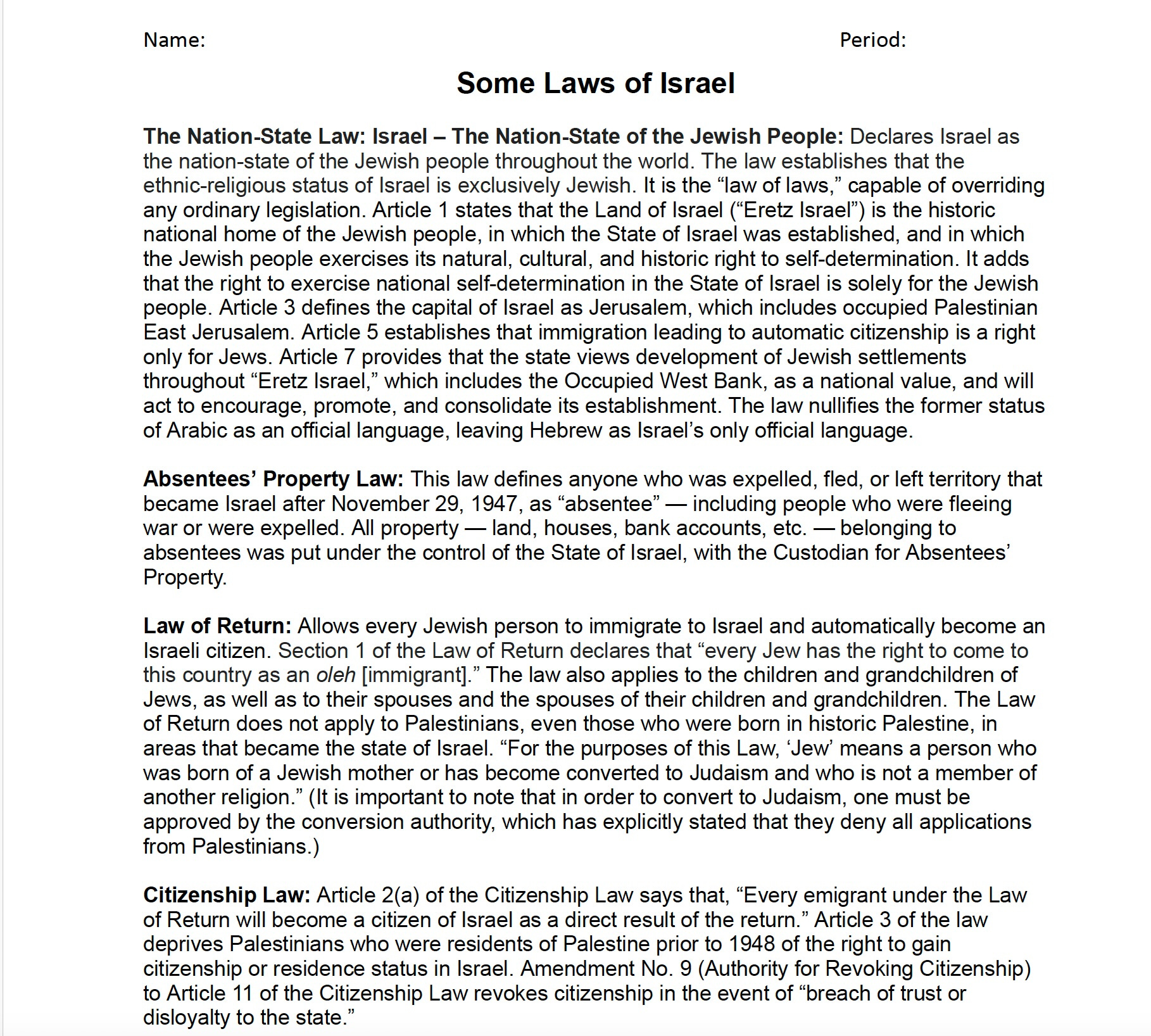
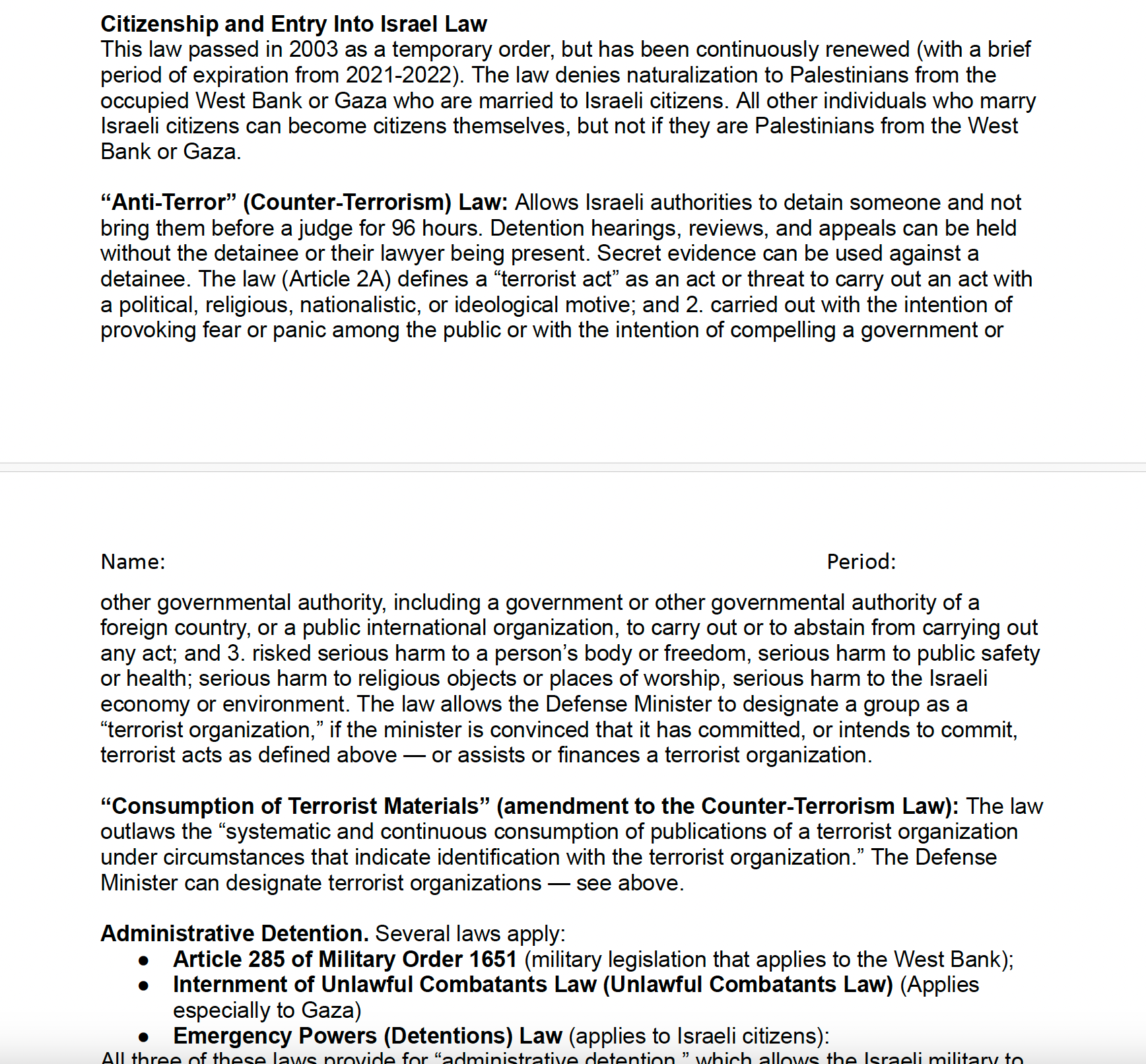
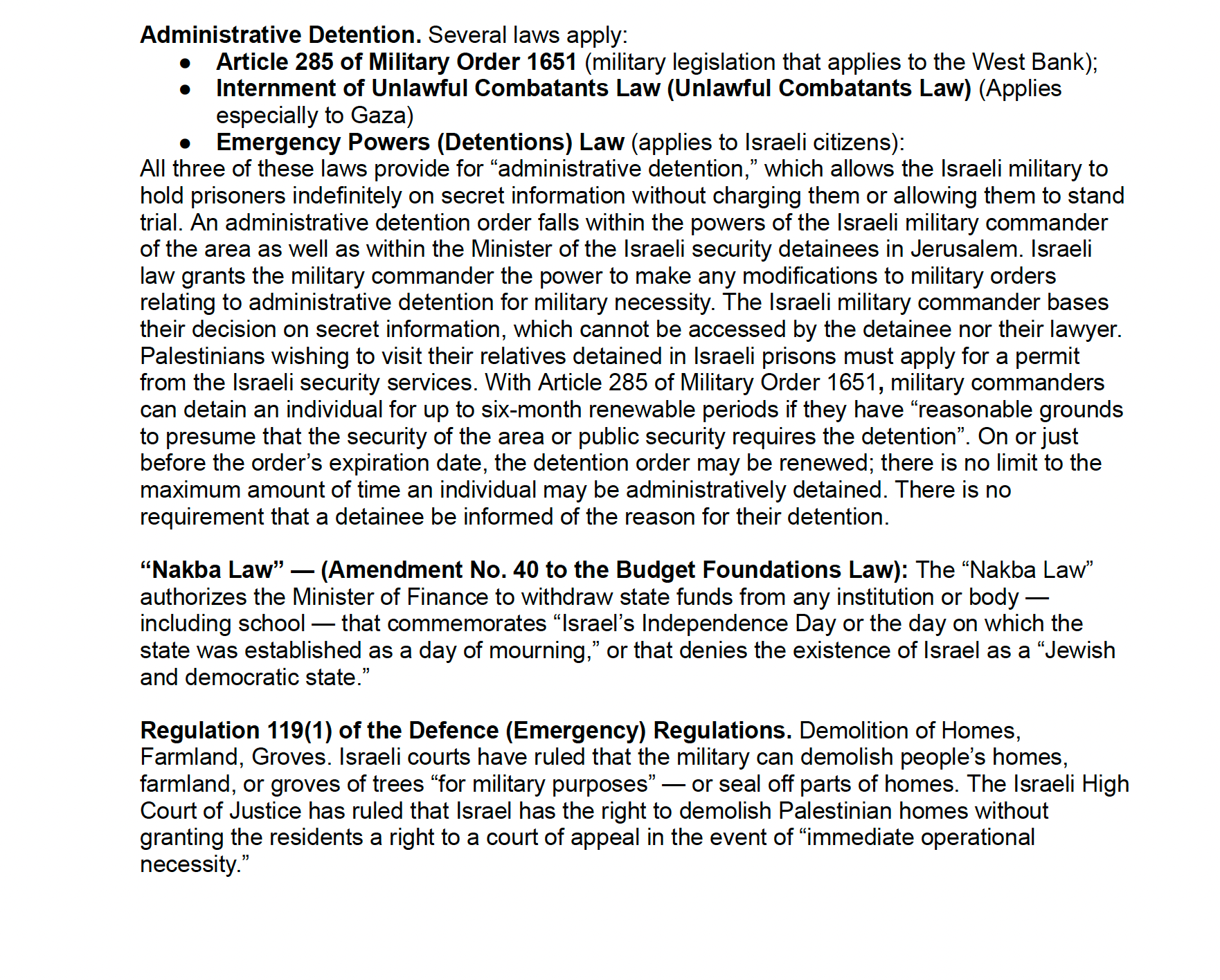
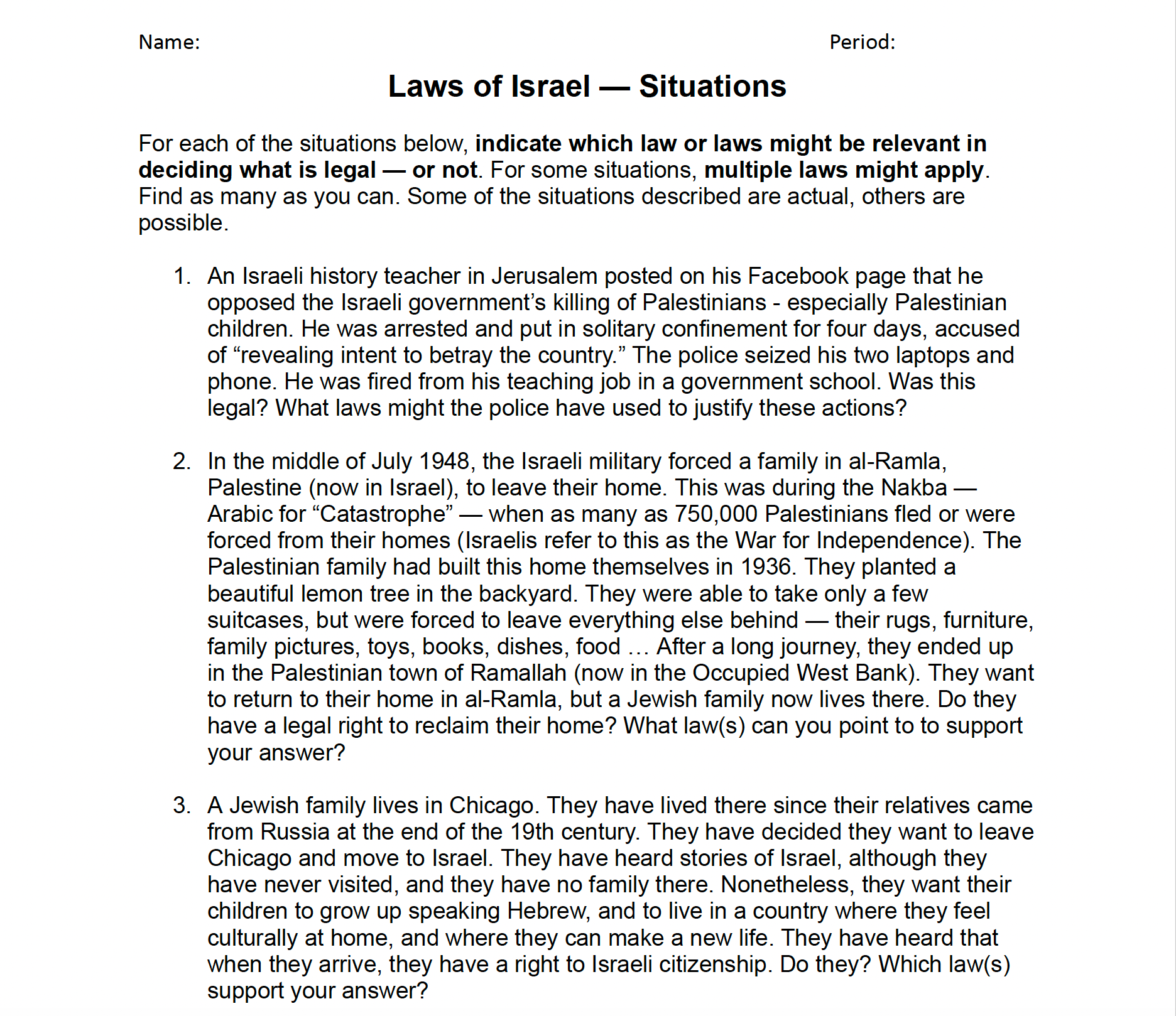
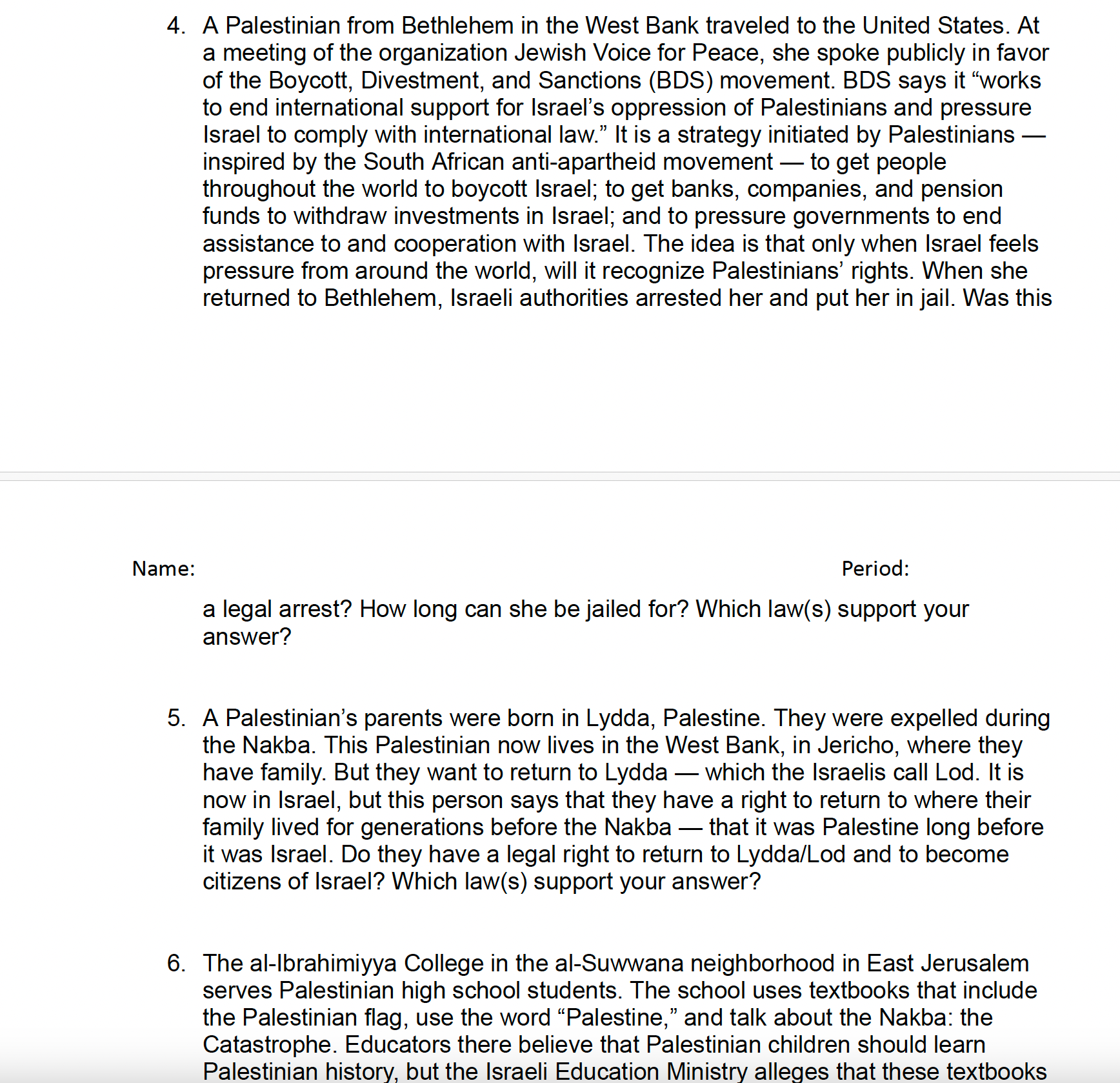
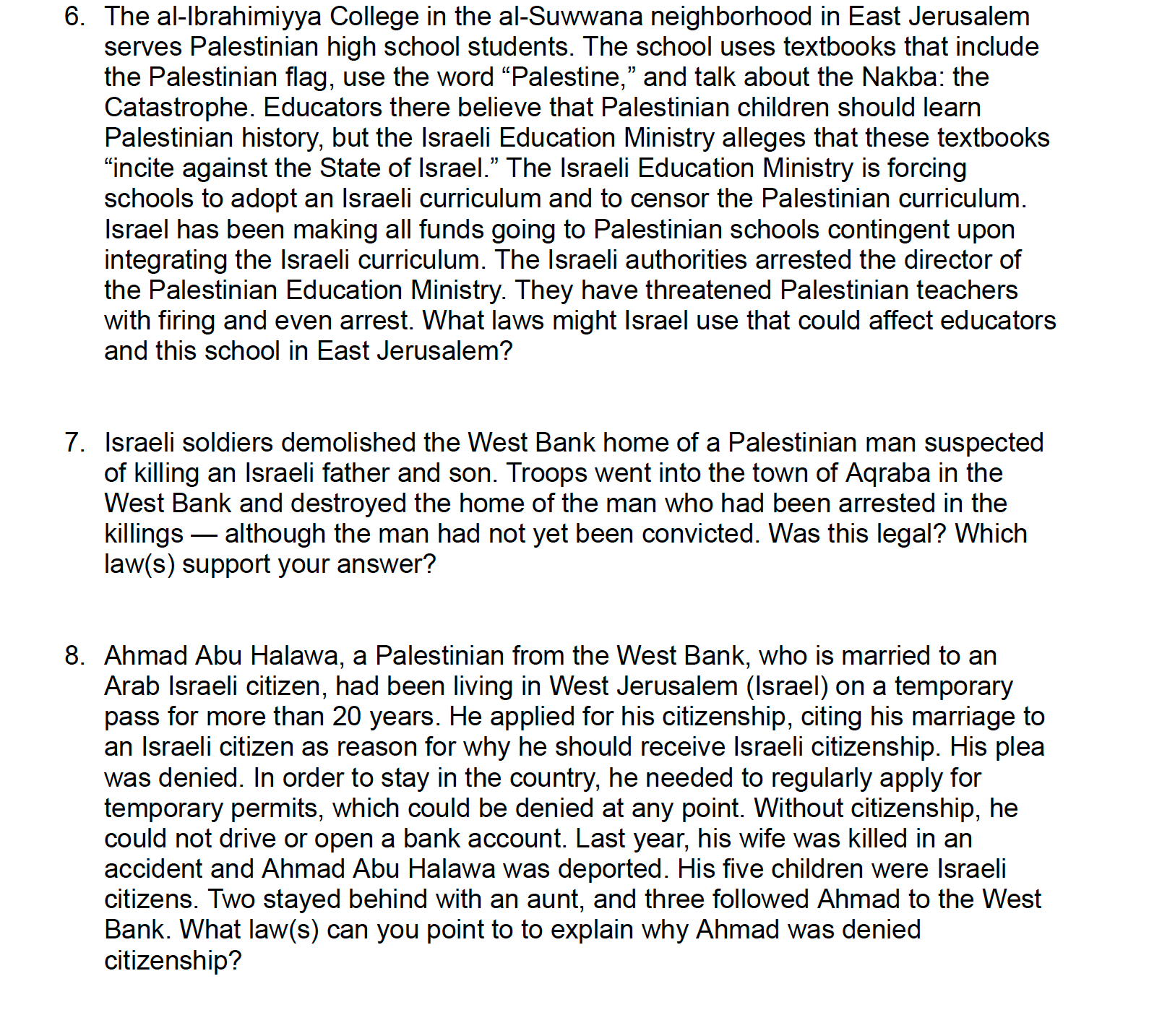
In this session, participants were given certain Israeli laws to review and discuss and then were given “situations” to analyze and determine which laws might apply.
Adam Sanchez:
So obviously the book has, we’ve really only scratched the surface of what’s in the book and it’s got lessons we started with some of the more kind of historical lessons that focus on before 1948 and 1948 obviously is a key year to understand. Then we talked about the US role and kind of looking at the 50 years and how that role has changed over time. And then there’s also lessons like this one that talk about these words that are often thrown about in left circles to describe Israel, “apartheid”, “settler colonialism”, these sort of things. So there’s another lesson in there on settler colonialism and really just getting kids to understand what are these terms and do you think, here are the laws, do you think this applies? Would you use this term? The settler colonialism lesson gives different examples of settler colonialism and actually asked students to come up with a term for it.
And then they learn the terms settler colonialism, they look at similarities and differences across different examples. But there is so much in the book that we knew that we were not in three sessions, not really going to be able to delve into that too much. So what we wanted to do is end with what in an in-person classroom or in-person workshop would be a gallery walk. So we’d have it around the room and you would look, and these are basically quotes and art and different bits from the book that we think might be particularly helpful to look at.
…
And I will just say, I think we don’t have enough in the book on Palestinian resistance. The lesson we did last class does talk about the first Intifada, the second Intifada, but it really looks at it through the lens of the United States and what the United States should do about that, not so much in terms of Palestinian resistance. And so this, we like to think of our books at Rethinking Schools as works in progress. And the hope is eventually we would come up with a second edition. And I think that’s kind of on the top of our list in terms of holes in the book that we need to fill is really thinking about the flourishing of Palestinian resistance. And in particular, there’s been huge nonviolent resistance, which is never focused on in the United States.
Kassouf says she has spent time trying to consider the “counterpoints” to the Palestinian narrative because she has Jewish students in her class. Still, she says, she can find no justifications. Kassouf has taught “Israeli Apartheid: A Simulation.” to her students and shown them this video in her class:
Susanna Kassouf:
but then it’s also criminalized when we think about banning the BDS movement, the boycott, divested sanction movement and things like that, things like that. And also a lot of the nonviolent resistance has been led by women in Palestine, and I think it would just be so interesting to explore that more.
…
And one thing, I mean, as a teacher, when I taught this unit, I have many, many, many Jewish students in my class, in my school community. It’s huge. And they have a range of views of this. And actually when I took this, I had no Arab students that year that I really, really dove in with a big unit. So I spend a lot of time kind of looking into counterpoints just so I could understand. And I think something I try to come back to over and over and over again, and I don’t want to just come out and say this, but you want to help people get to this on their own, is that there is no justification for killing even a single child.
There is no way to justify it. And you can give this reason and that reason and this reason and that reason. But that in itself is wrong. And I think most people know and understand that Ta-Nehisi Coates has had this great answer in an interview where the interviewer was trying to say in his book, he didn’t mention enough about why they have these, what he calls apartheid laws, because they have to keep themselves safe. And he basically is like, I’m against the death penalty, whether it’s because you had weed on you or because you murdered people, I’m against the death penalty. Apartheid is either right or it’s wrong. And I think coming back to that over and over again, the core humanity of every single person, and that there is no way to justify it no matter what is what I would say
Adam Sanchez:
And just to add to that, we have a whole chapter in the book that we didn’t really get into, much called “Challenging Zionism and Antisemitism”, and it’s got the very first article in there is this wonderful piece, “what antisemitism is and what it is not”, which I think is a really accessible piece by two incredible authors who work with Jewish Voice for Peace. But I’ll just say one thing that I think as a Jew, as someone who grew up in a Zionist family, a big part of how that is inculcated is through just Hebrew schools and a narrative that is cutting you off to other narratives about what happened. And so it’s when I actually went to college and made Palestinian friends and heard the Palestinian perspective and actually was confronted with a history that I actually didn’t know,that I realized, wow, this actually totally conflicts with what I’ve been told my whole life are Jewish values.
And I think it’s important to say that there, and I’m writing an article about this right now, but there was a conscious effort that came out of in the late 1960s and 1970s to redefine antisemitism as this new antisemitism. There was a shared definition of antisemitism up until the 1960s that most people operated off, but there were right wing Jews in Jewish organizations like the Anti-Defamation League and others like that, that were Zionist organizations that began to redefine what antisemitism was and create. It actually came out of this boogeyman of black antisemitism during the black power movement and the civil rights movement. And so the idea was up until now, antisemitism has been defined as coming from the racist logics of the right while we think we can use it to kind of divide people on the left. And it was this conscious campaign to root antisemitism not in the right as it had been before and in the left, and at the same time to get Jewish people to identify more with Zionism.
The authors of Teaching Palestine deny their bias because, they argue, they are clearly non-neutral in how they teach:
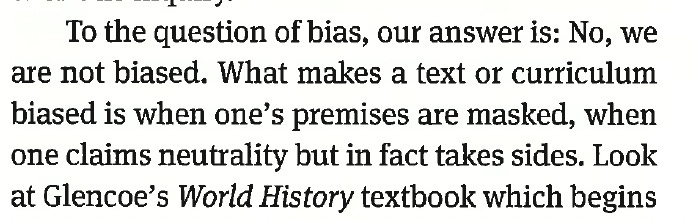
They have plainly “taken a side”. And they are teaching this side, with bias, slanted facts and potted history, to students in the classroom, and to teachers through study groups, education schools like UCLA’s Center X, and seminars at teacher association conventions, like the New Jersey Education Association’s upcoming convention where Adam Sanchez will be presenting a seminar on “Teaching Palestine.”
Is it any wonder that, like the participants in this workshop, students are coming away from school believing that Israel is the aggressor and a settler colonial, apartheid state? Or that students, like those in Sanchez’s class, might come to think of October 7 as an understandable act of “frustration?”
I must ask: how effective is it to expose them? What is done following this exposure? This curriculum is not only biased, it is historical revisionism, falsehoods and lies. What about truth in education? Who supervises the accuracy of materials for k-12? Can anyone just teach anything? Does exposing this lead to removal of the materials from the schools or does it remain only exposing and that's it? Thanks
They are not teachers, they are indoctrinators and enablers of Palestinian terrorism.