
Inside The Antisemitic Antisemitism Training Aimed At School Districts

PARCEO held a training on its antisemitism curriculum for members of Jewish Voice for Peace last night. PARCEO, which calls itself an education, research and resource center, is positioning itself as an alternative provider of antisemitism curriculum and professional development services for K-12 educators. For example, when teachers in San Francisco Unified School District refused to attend antisemitism training by the American Jewish Committee, PARCEO stepped in with an alternative.
PARCEO’s curriculum “Antisemitism from a framework of Collective Liberation,” explicitly seeks to decouple Judaism from ties to Israel. Anti-Zionist educators are pushing it as a more authoritative source on antisemitism than legacy Jewish institutions. PARCEO co-directors Nina Mehta and Donna Nevel are activists who contributed a chapter to Rethinking Schools’ Teaching Palestine: What Antisemitism Is and What It Is Not.
Key Points
It is important to note three things.
PARCEO admits that the motivations and purpose of this curriculum are explicitly political and activist. Anti-Israel activists asked them to develop a curriculum on antisemitism for the purposes of the broader anti-Israel movement.
Incredibly, PARCEO argues that antisemitism does not exist on the left. To them, it is a solely right-wing phenomenon.
PARCEO emphasizes the diversity of the Jewish community and Jewish experience, yet it has a view of antisemitism that is almost entirely Eurocentric. This blindspot can only be understood by the determination to ignore Judaism’s inextricable tie to Israel, Jewish indigeneity to Israel, and the need for a Jewish homeland.
The Curriculum:
This training was held by PARCEO co-director, Nina Mehta.
The training reveals, above all, the gross double standard held against Jews in progressive circles. Throughout the training, Mehta opines on the danger to Jews of “exceptionalizing” antisemitism. Yet, PARCEO’s understanding of antisemitism does something worse - it exceptionalizes Jews : Jews may not have self-determination in their homeland, Palestinians may; Jews cannot be indigenous to Israel, Palestinians can; Jews cannot mourn their dead without first acknowledging other groups. This does nothing if not “exceptionalize” and “isolate” Jews. This is nothing if not antisemitic.
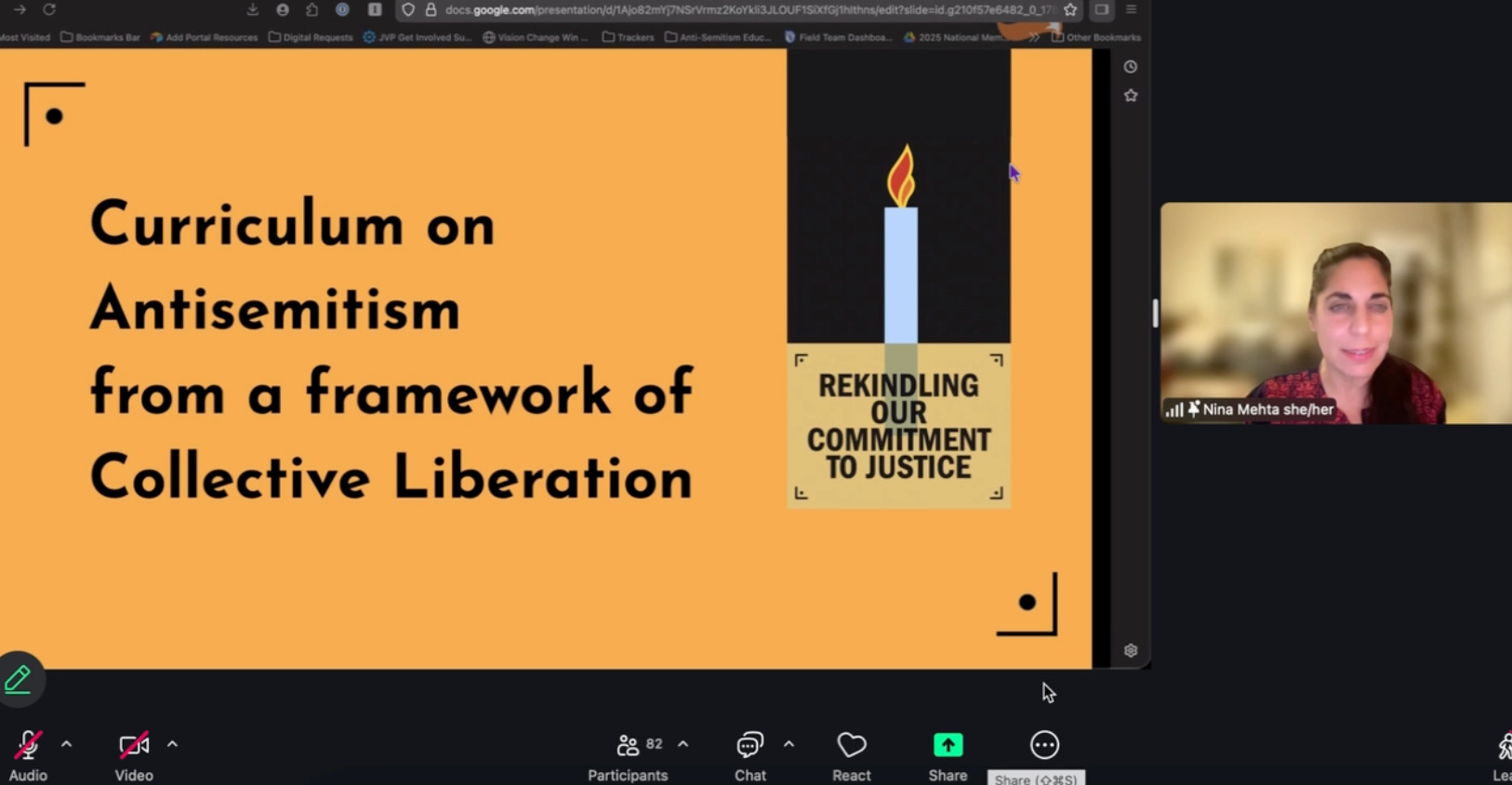
Mehta makes clear from the start that this curriculum was created at the request of anti-Israel activists.
And to share a bit of a background of how and why our curriculum on antisemitism from a framework of collective liberation has evolved at this moment. So this curriculum we created grew out of many requests and conversations with educators and with our longtime partners in social justice organizations, including JVP. And our movement partners articulated a need for workshops that addressed antisemitism from a collective liberation lens, and that made clear what antisemitism was and what it wasn’t, including disrupting the dangerous framing of anti-Zionism and criticism of Israel as antisemitism (emphasis added).
The development of the curriculum, she says, began “well before the October 2023 genocide.”
Mehta calls the Anti-Defamation League’s curriculum “dangerous” and notes that PARCEO has been brought into develop lessons, resources and training for teachers and students.
So our foundational framing has been rooted in a dynamic, interactive relationship with our movements and struggles for justice and the needs emerging from those relationships and from our work together. For example, with so many of our groups resisting the Anti-Defamation League’s dangerous curriculum and ideology in our schools, we’ve been brought in to facilitate more and more workshops with teachers and with students and are now developing lesson plans and resources for teachers to be able to have for their schools and for their classrooms, or for universities and organizations and labor and faith-based groups who are under attack or who have mandated antisemitism trainings or just don’t want to offer a different kind of workshop (emphasis added).
So most importantly though, we know that political education is an integral part of the organizing. It’s not an add-on. And we also know that our workshops and other political and community education initiatives are not operating in isolation. We are part of a broader movement, a movement that’s been organizing, and we were asked to fulfill a need at a moment that grew out of that robust organizing.
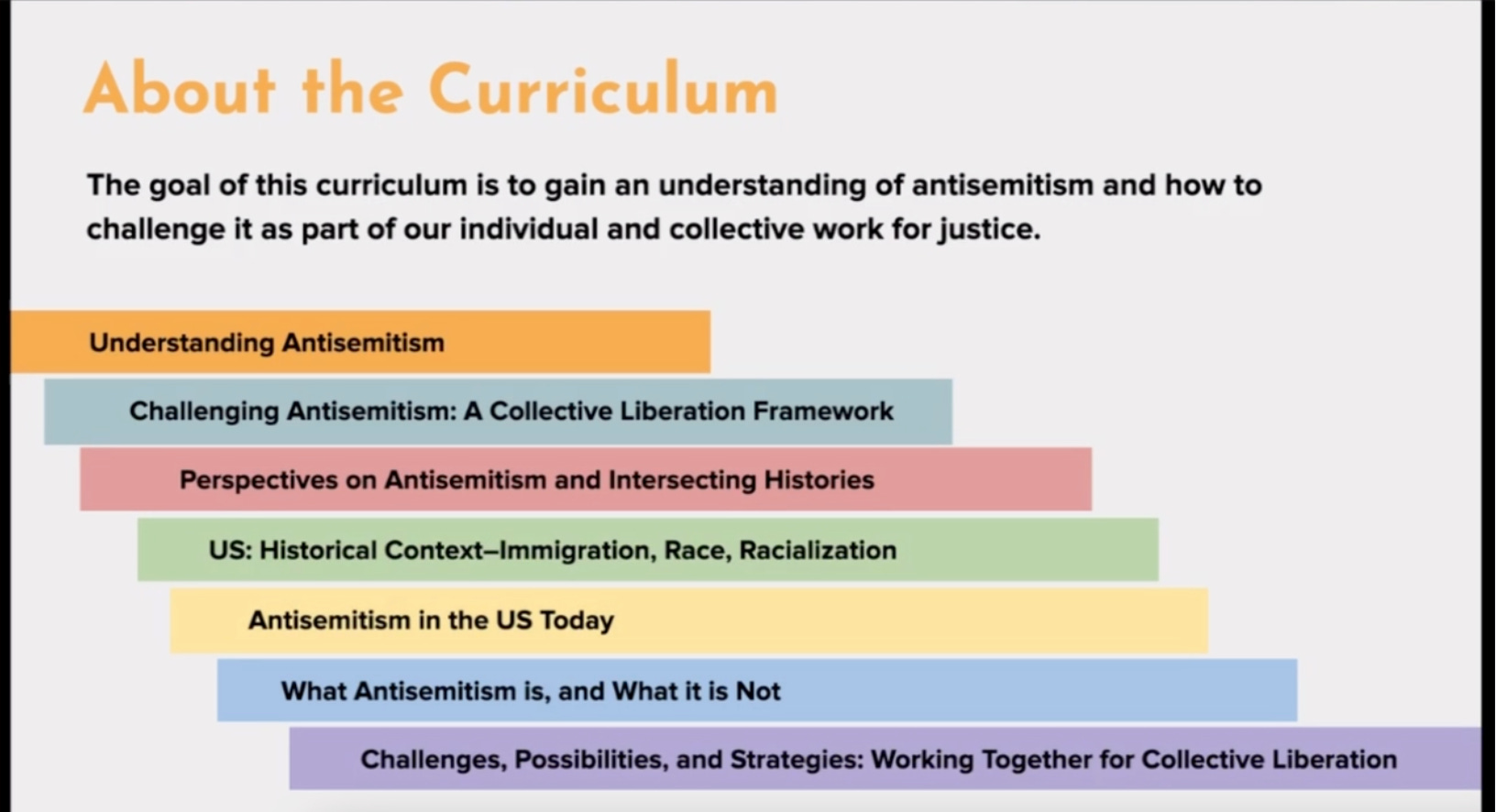
The curriculum and our workshop tonight opens with some basic understandings of what antisemitism is and what follows is some historical context of Jewish experience and antisemitism. From there, the focus is on antisemitism in the United States historically and currently, as well as the ways antisemitism is misused to serve an anti-liberatory political agenda. In order to understand what antisemitism is, it is also important to know what it is not. And then the curriculum moves to an exploration of fighting antisemitism as part of a broader commitment to liberation and why we must resist the exceptionalization of antisemitism from how we understand who is entitled or who has the right to speak about antisemitism to the ways that isolating it from other struggles is harmful to our work for justice.
And in this exploration of antisemitism, we are deeply aware of the breadth and depth of Jewish experience and histories. Jews reflect racially, ethnically, economically, and culturally diverse communities that have lived throughout the globe for centuries. There are white Jews, Jews of color, including me, and Jews from different parts of the world, including Africa, Asia, Europe, Latin America, the Middle East. And along with the diversity of races and geographies, there is a plurality of Jewish ethnic groups, Ashkenazi Jews who are from Eastern and Western Europe and Russia, Mizrachi Jews and J-SWENA who originate from Middle Eastern, north African, and central Asian countries, Sephardic Jews from Spanish and Portuguese backgrounds, and from Balkan countries, Jews from Ethiopia, Uganda, India, and China. And this helps us to understand how anti-Semitism and Jewish experience is so diverse in its manifestations.
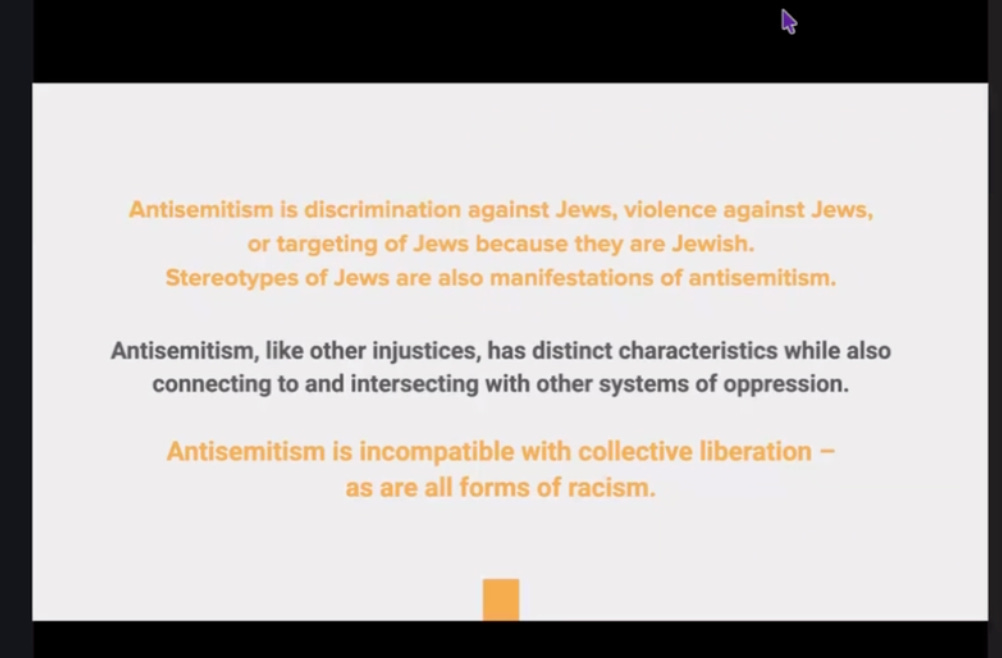
So when talking about antisemitism, one cannot focus only on the experiences of white Ashkenazi Jews. To do so is to contribute to the ongoing erasure of Mizrahi Jews and Jewish communities, and to perpetuate the idea that European Jewish history is the history of all Jews. And let’s go back one more. True historians differ over a precise definition, quite understandably, given that the term was coined only in the 1870s and was then used to describe varieties of Jew hatred going back 2000 years. But I would argue that in practice during the first three or four decades after the Second World War, antisemitism was commonly linked to the classical stereotypical image of the Jew forged in Christendom, adopted and adapted by antisemitic political groups in the 19th century and further developed by race theorists and the Nazis in the 20th century.
The discussion moves to the need to understand and challenge antisemitism from “ a framework of collective liberation.” Mehta shares a brief clip of a roundtable held with Jewish Voice for Peace activist, Lesley Williams, Executive Director of Arab Resource and Organizing Center, Lara Kiswani, and Columbia Professor Nyle Fort. This roundtable was part of the process of developing PARCEO’s antisemitism curriculum.
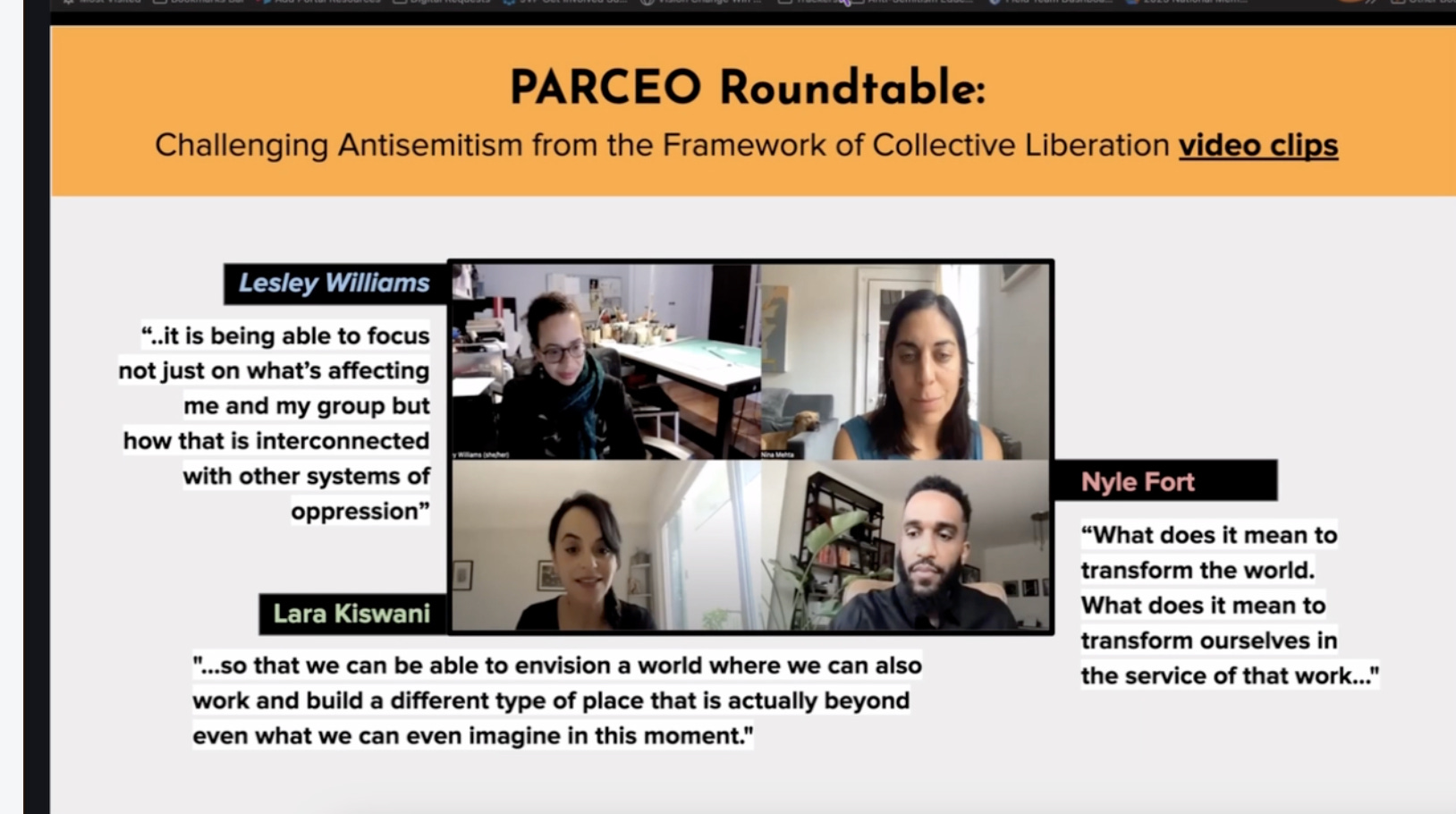
Here is Nyle Fort in 2020 engaging in the antisemitic “deadly exchange” conspiracy about Israel impacting police operations and policy in the United States. Fort thinks that the United States gives Israel “10 million dollars a day to oppress Palestinians and maintain global dominance.”
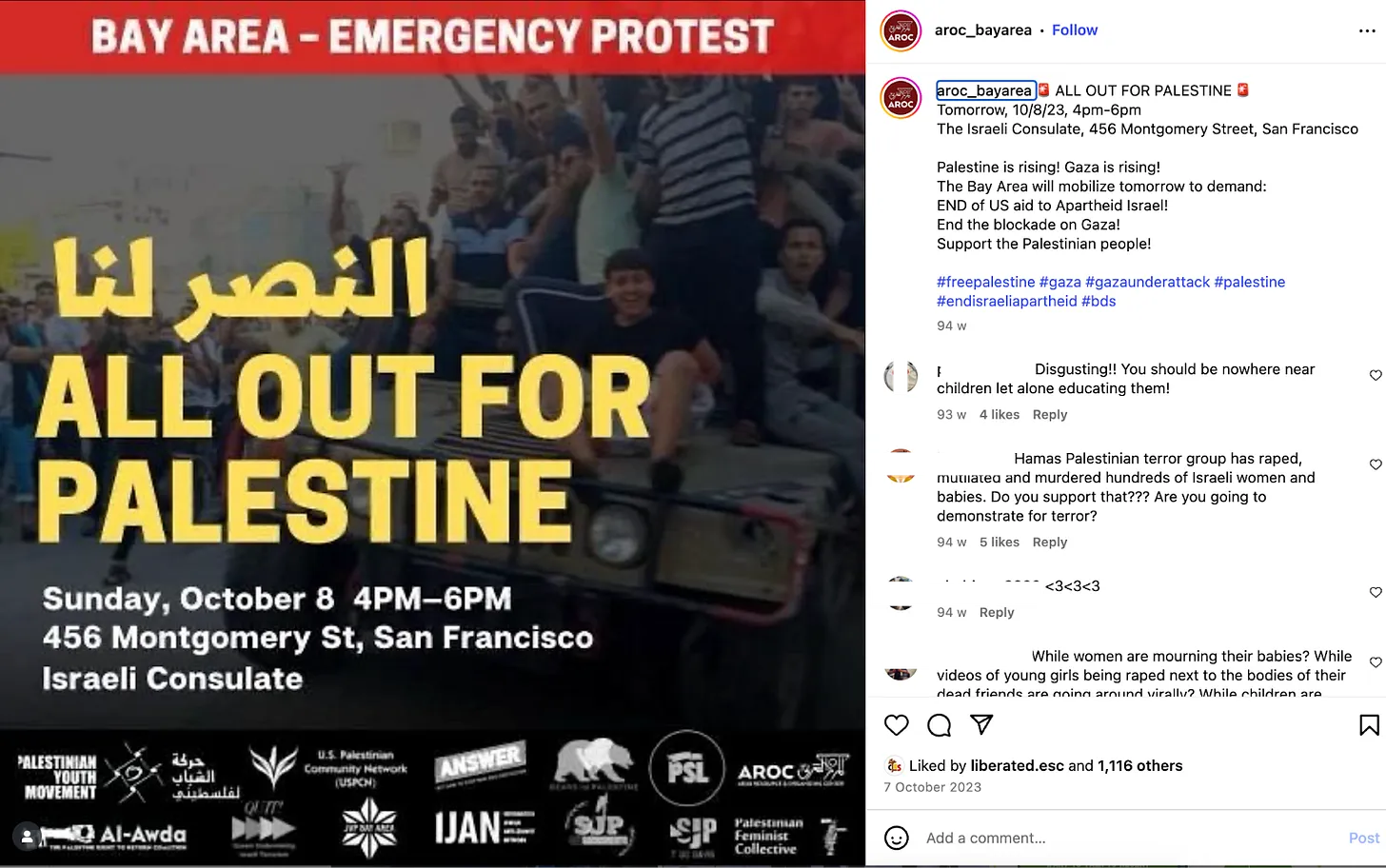
Kiswani’s AROC celebrated the October 7, 2023 Hamas massacre.
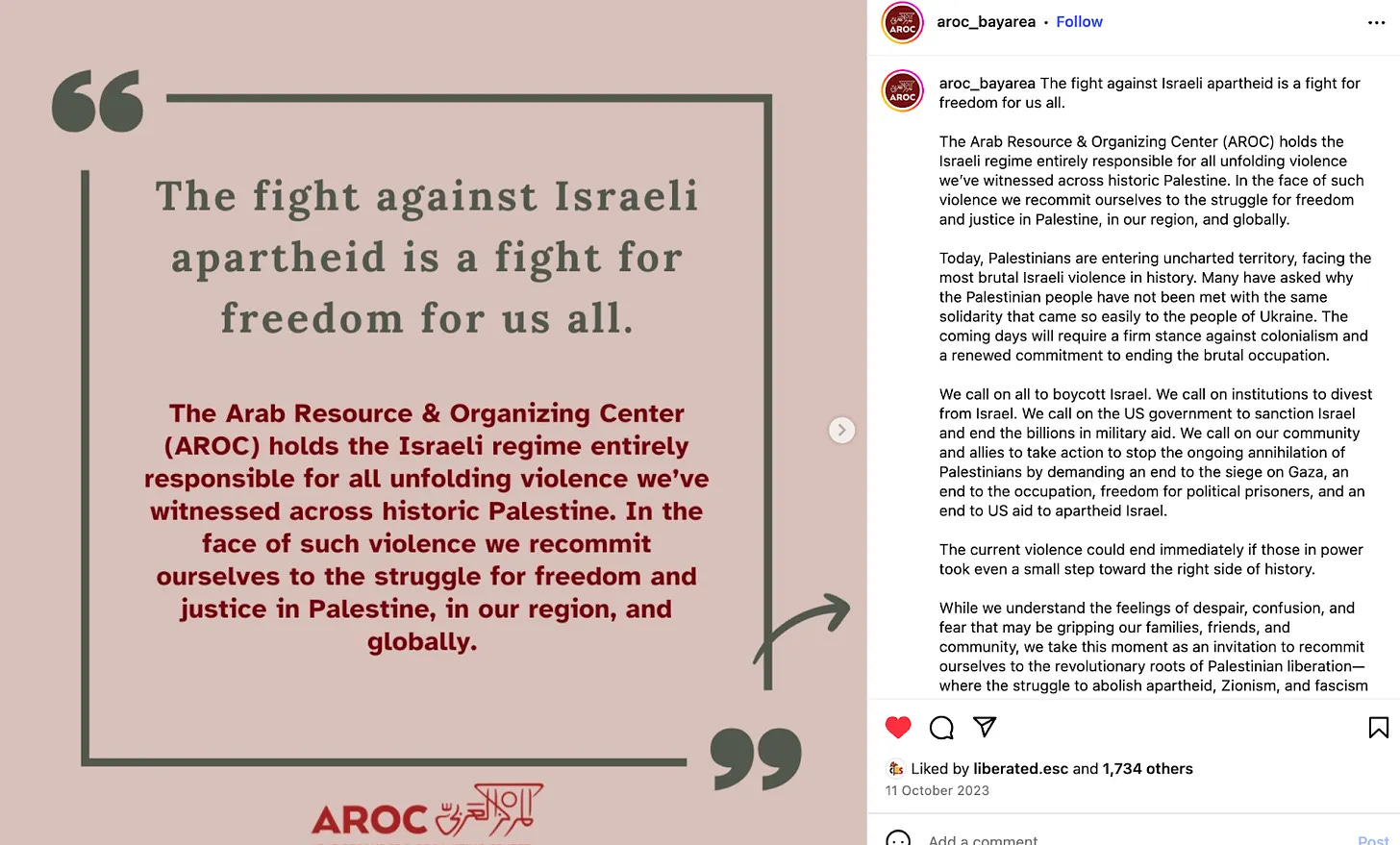
“The Arab Resource & Organizing Center (AROC) holds the Israeli regime entirely responsible for all unfolding violence we’ve witnessed across historic Palestine. In the face of such violence we recommit ourselves to the struggle for freedom and justice in Palestine, in our region, and globally.
Today, Palestinians are entering uncharted territory, facing the most brutal Israeli violence in history. Many have asked why the Palestinian people have not been met with the same solidarity that came so easily to the people of Ukraine. The coming days will require a firm stance against colonialism and a renewed commitment to ending the brutal occupation.
While we understand the feelings of despair, confusion, and fear that may be gripping our families, friends, and community, we take this moment as an invitation to recommit ourselves to the revolutionary roots of Palestinian liberation—where the struggle to abolish apartheid, Zionism, and fascism in our homeland is one and the same with an international struggle for economic and political democracy, for education and healthcare for all, for right relations to land, for social justice, gender justice and climate justice, shaped in the interests of working people. (emphasis added)”
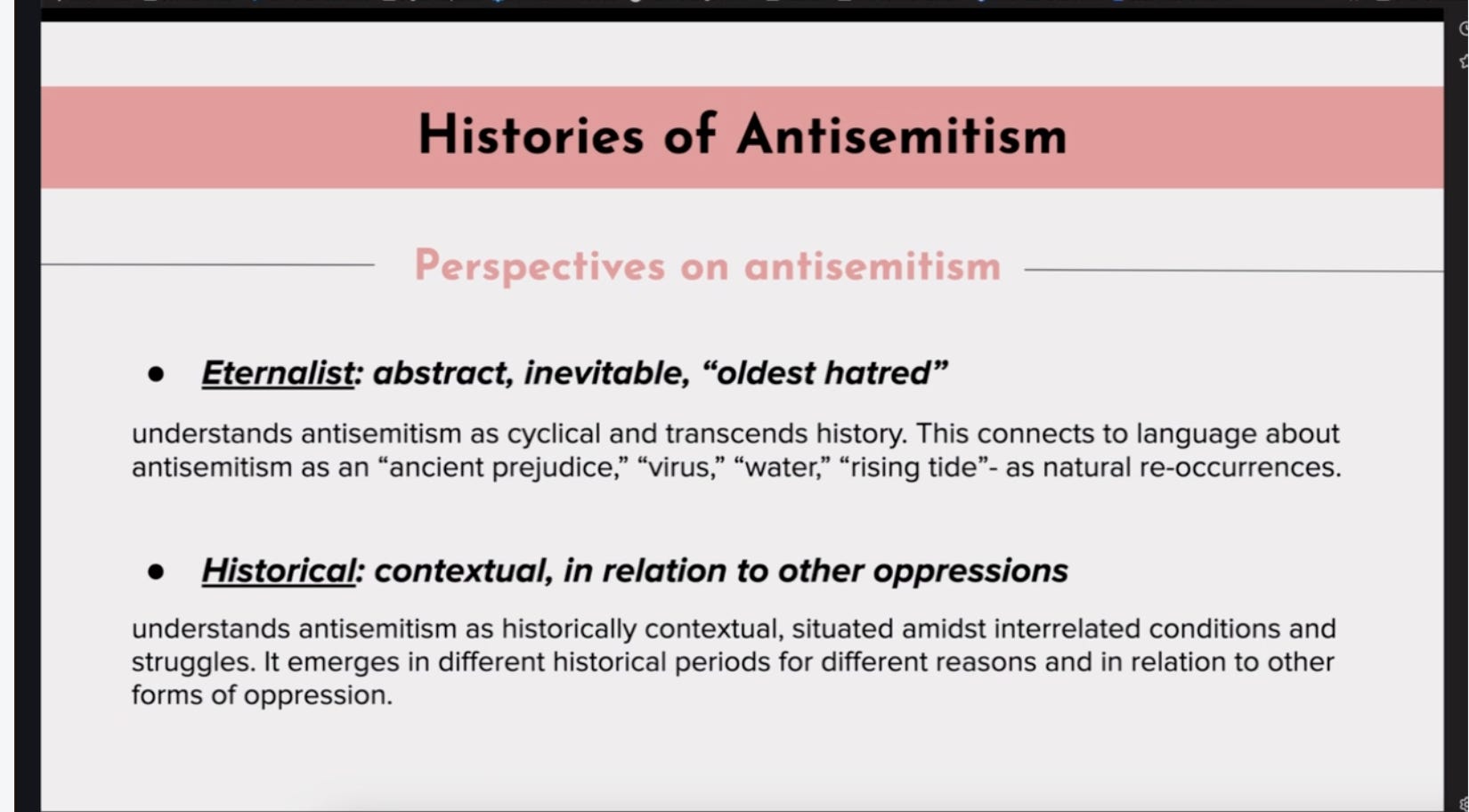
There are two clearly distinct views of the history of antisemitism that impact how antisemitism is seen, felt, and experienced. One views antisemitism as eternal as a natural phenomenon. And in isolation from other forms of oppression, it puts forth that antisemitism is a given, it’s never ending, it can’t be understood, and it can’t be stopped. This perspective sees Jews as always under threat. It is us versus them. The other perspective, which is the one that we adhere to in this curriculum, understands antisemitism as historically contextual, situated amidst interrelated conditions and struggles. It emerges in different historical periods for different reasons and in relation to other forms of oppression. That is, when looking at Jewish experience, the complexity of Jewish life and the reality of antisemitism in different locations, context is critical. These different understandings not only impact how we see antisemitism, but also how we think about responding to it that is distinct from or as part of and connected to other struggles against oppression (emphasis added).
And as we reflect on antisemitism, we look at some moments of Jewish experience and antisemitism through a historical perspective. So many of these time periods are likely familiar, but different from some traditional renderings of Jewish history, from organizations like the ADL. We look at the intersections or the other targets of systemic violence and oppression, the ways that Jewish experience included, but was not limited to antisemitism and antisemitism in relation to local conditions, realities and contexts. So I’m going to share a couple of periods, but just to let you know, this is just a really brief, a small, small bit. We have a much longer section in the longer curriculum that goes into depth for each period, but I just kind of wanted a model for you, just like a different way of showing these timelines and these moments through a historical perspective. So we can go to the next slide (emphasis added).
Mehta glosses over the violence and oppression of Jewish communities in the Middle East to focus almost exclusively on European antisemitism.
So during early European Christianity, non-Christians face depression, pagans, heretics, and Jews, all who did not convert to Christianity. And during the Islamic golden age in North Africa, the Middle East, central Asia and Southern Europe, Jews built vibrant religious, cultural and economic lives. Jews living in these areas lived in greater security compared to Jews in different parts of Europe. Mizrachi Jews like Sephardic Jews under Muslim rule were often integrated into Muslim Arab and Berber societies, while also being subject to the rule of the dhimma, a special designation for certain religious minorities that signified both protection and second class legal status.
So this time period coincided with the high and late middle ages in Europe where many Jews had high levels of literacy, political autonomy, and economic comfort. However, conditions became increasingly oppressive, particularly for racialized religious others like Jews and Muslims. In this period, as we know, is where many tropes that have become very familiar originate. And the impact of the Spanish inquisition on Sephardic Jewry and Muslims, many of whom were targeted, killed and expelled, starting in 1492 for suspected heretical behavior was devastating. With the brutal colonization of the Americas, Spain sought to convert the indigenous inhabitants of the lands seized as well. This period also proliferated the transatlantic slave trade and colonial caste systems based again on a purity of blood ideology. The ongoing effects of this ideology on indigenous and enslaved African people cannot be overstated … medieval religious difference was a clear expression of racialization from a pre-enlightenment and pre-scientific revolution position. And we can see the multiple impacts of oppressive systems on different or really differently racialized groups that was happening at this time period.
As long as fascism has threatened politically, socially, and economically marginalized communities, antifascists and anti-racist formations have forcefully fought back in Europe and the U.S. For example, antifascist collective resistance coalesced in the 1920s and thirties, the Jewish labor Bundt was one such formation that joined in the fight against fascism. Other formations included global anti-fascist groups fighting against regimes such as Franco’s in Spain. Just good to remember these histories at this time. Right? We can go to the next slide please.
Jews were targets of Nazi violence with over 6 million Jewish victims of the genocide. As we know, this is the most extreme brutal antisemitic period in Jewish history. The Nazis also brutalized and persecuted millions of other people on a racial and political basis, including queer people, those with disabilities, Roma Poles and other Slavic peoples, Jehovah’s Witnesses and communists and members of political opposition groups. And this of course also connects to the ways that US British and German eugenicists worked closely with one another in the late 19th and early 20th centuries. For example, German legal scholars visited the United States to study US racial laws to assess their applicability to them. So again, this just gives a sense of how Jewish history across the globe and experience of antisemitism interacted and intersected with other forms of oppression and were impacted by local contexts and conditions. European Christian antisemitism, as well as Islamophobia and other forms of racism, were among the foundational elements that othered and dehumanized all who were deemed outside of the white Christian nation. And we understand how this has impacted so much of western nation state building while also impacting lives in the US. Christian hegemony has impacted and shaped the experiences for so many different religious minorities, including Jews in so many different ways. Manifestations of, for example, anti-Jewish and anti-Muslim and anti Hindu attitudes and behaviors have intersected with racist ideologies while a general privileging and accepting of Christian dominance is just internalized. I see this with my kid who’s like, when are we getting a Christmas tree? It’s just pervasive, right? So just thought that this could be another moment where write in any thoughts? Just a check in (emphasis added).
Mehta glosses over antisemitism in the Islamic world and antisemitism in the Soviet Union is ignored entirely (although she does give a nod to pogroms and persecution in Eastern Europe as a motivating factor Jewish immigration to the United States).
So in the next slides we look more at the ways that antisemitism has manifested historically in the U.S. We consider the changing realities socially, politically, economically for Jews immigrating to the US amidst the background of Christian hegemony. And we look at how and to what extent Jewish immigrants became integrated into US dominant society.
…
These immigrants as well as other immigrant groups that came at the same time as Jewish immigrants faced anti-immigrant discrimination and capitalist exploitation. We also know, of course, that African-Americans and Native Americans continue to face severe marginalization, violence and racism that characterize the long history of racism and exploitation rooted in white supremacist structures and ideology.
….
So we look at how Jews have come to understand their own relationship torace and racialization in the context of broader social, political, and economic conditions and realities, which really necessitates a consideration of how and when some Jews became racialized and importantly identified as white in the United States. Of course, we understand that we all bring with us and have different, often multiple, identities. And so for example, Jews who are white can both benefit as white people while also facing antisemitism, which is different from the experience of white Christian people.
And at the same time.. antisemitism is not inconsistent with the privileges and powers granted to white American Jews, not as an inevitable symptom of antisemitism, but as a symptom of whiteness, white supremacy, and an ability and willingness of many white American Jews to align themselves with an imagined Judeo-Christian West (emphasis added).
Mehta goes on to talk about antisemitism in the U.S. today which comes, she believes, exclusively from white nationalism and from the right.
Mehta says that when it comes to understanding antisemitic tropes, “context” is important:
We also need to be very aware when accusations of antisemitic tropes are misapplied so that we don’t falsely accuse people of antisemitism. So to give a concrete example in response to representative Ihlan Omar being called antisemitic for saying “it’s all about the Benjamins” in relation to AIPAC. Well, it’s not antisemitic to say that a lobby group is using money to influence politics, right?
Mehta is very clear that antisemitism does not exist on the left.
So interesting.. the antisemitism on the left. So address that really quickly. So we really resist the notion. We hear sometimes that there is an issue with antisemitism on the left. Can individual people on the left or who call themselves pro-Palestine or anti-Zionists say something antisemitic? Of course, anybody from any community can say something antisemitic that goes against the ideology that they claim to espouse. But two things. One is that it’s not specific to the left, it’s just antisemitic. And two, if someone on the left says something, antisemitic, again, not critique of Israel or Zionism, nothing to do with that. But if they say something that is actually antisemitic as a movement as the left, we denounce it. Right? I mean, that’s sort of how we approach that question of antisemitism on the left. It’s just antisemitism that again, can be that we denounce. Right?(emphasis added)
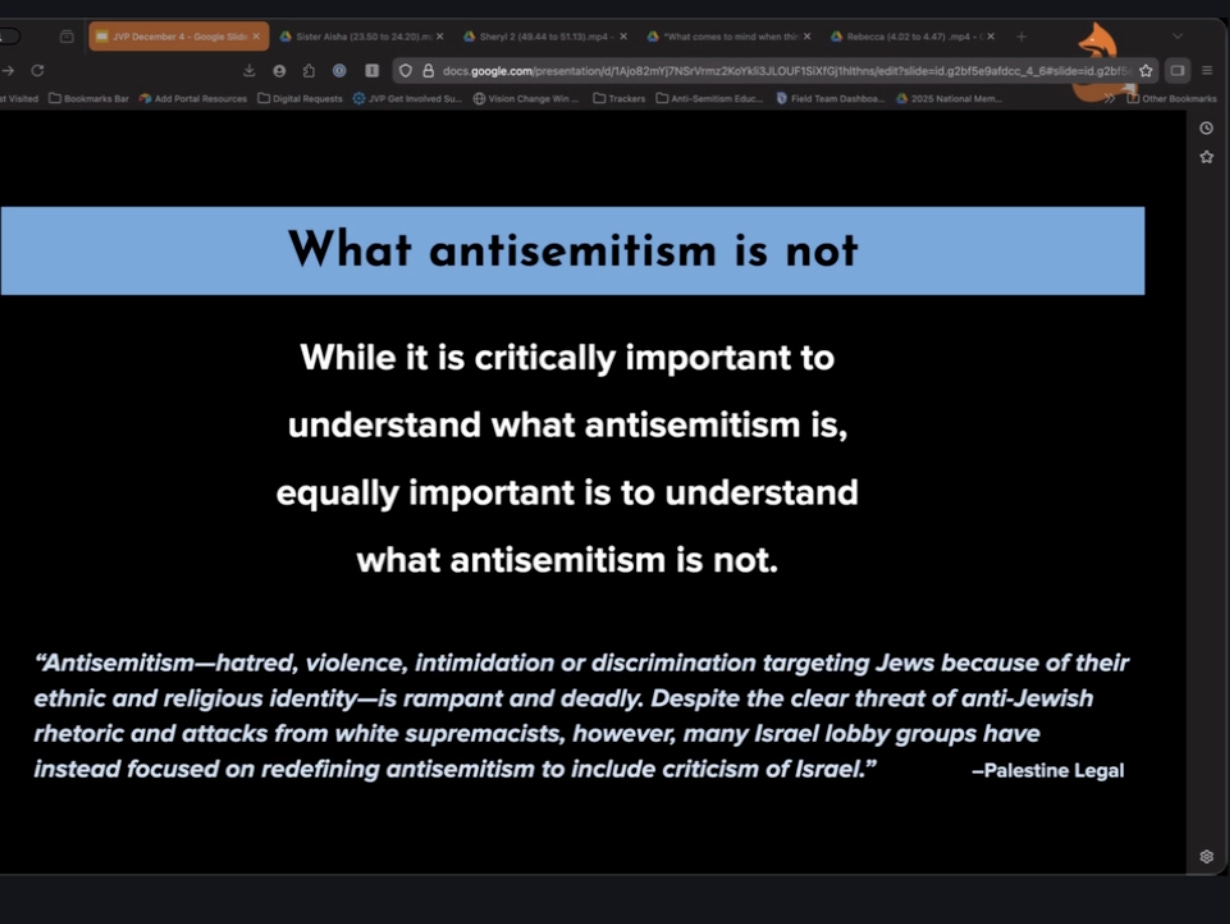
So as we continue to think about antisemitism historically and currently, and particularly how it manifests today, we know that to challenge antisemitism effectively, we not only need to know what it is, but it’s critical to know what it is not. Misunderstandings and intentional misrepresentations of antisemitism derail the struggle to challenge antisemitism and further political goals that are harmful to our work for justice, which of course includes challenging antisemitism. Let’s go to the next slide, please and I will read this. But as we look at this excerpt, we also recognize enormous harm of this distorted and incorrect understanding of antisemitism. So the word antisemitism matters because it is heavy with history echoing with a sound of shattering glass. As a result. It is not only a difficult word, but a dangerous one for it is a word that can do harm if it is misused. Yes, it is a label that we need a name for, something that needs naming and denouncing, but a label can turn into a libel when it is pinned on the wrong lapel. Antisemitism has rightly been called a monster, but false accusations of antisemitism are monstrous too.
Mehta then launches into a bad faith reading of the IHRA definition of antisemitism:
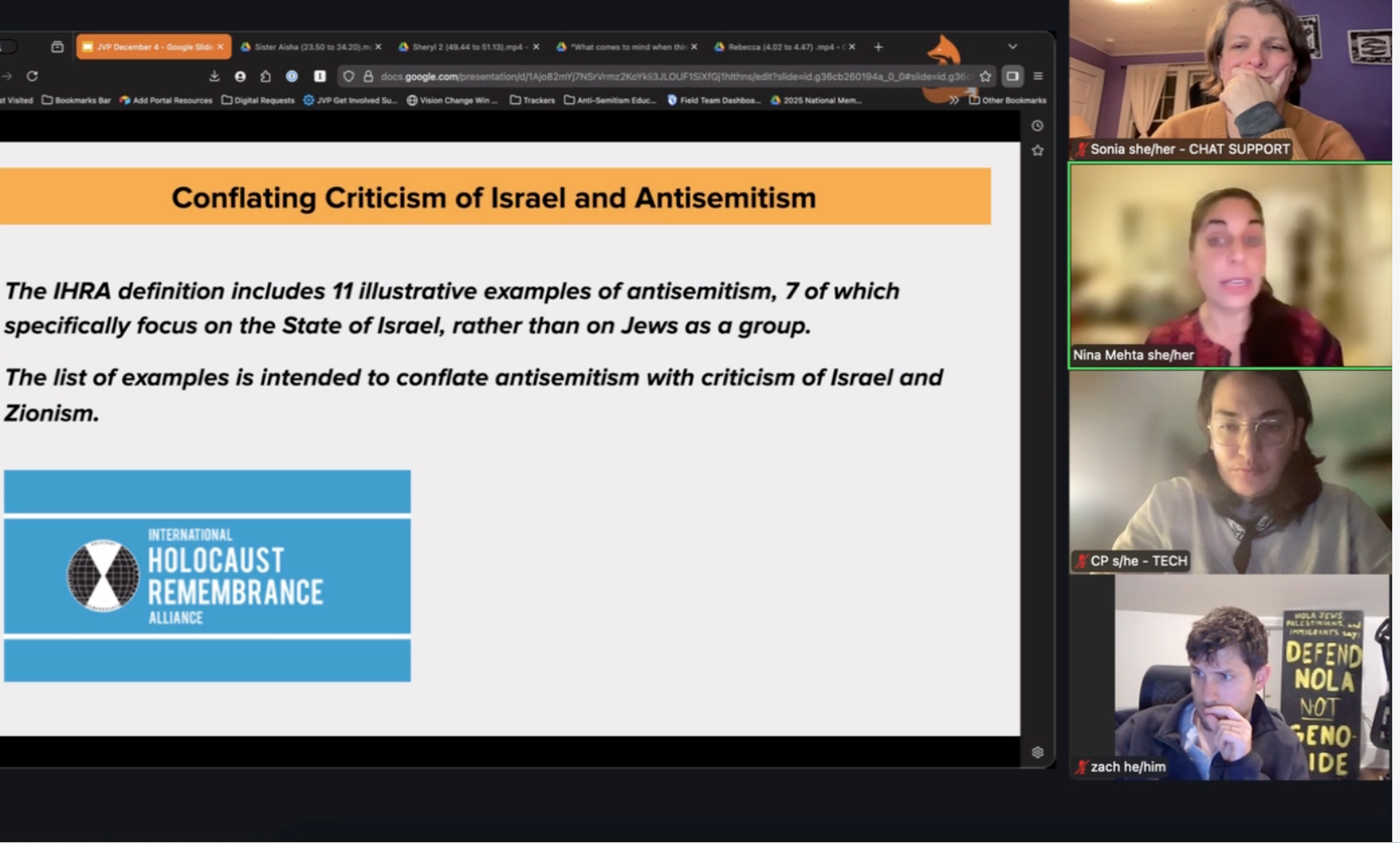
…there have been changing needs and realities that we’ve responded to as we facilitate the curriculum. And for many the International Holocaust Remembrance Alliance working definition on antisemitism or the IHRA was something that had not really been on people’s consciousness when we first started our workshops. But in the past couple of years, for those of us in the Palestine solidarity community, it is unfortunately a household word. We know too well that IHRA is not designed to clarify what antisemitism is, but rather to conflate antisemitism with criticism of Israel or Zionism. The IHRA definition includes 11 examples of antisemitism, seven of which specifically focus on the state of Israel and not on Jews. Currently, IHRA is becoming a legal benchmark for defining antisemitism and has been adopted by universities and pushed in many ways by our administration. States and cities have also adopted a legislative definition of antisemitism while never proposing a definition of any other form of racism.
Mehta does not share the IHRA definition with the webinar participants. If she did, they would see that her characterization of the definition is…misleading.
Here is what the IHRA definition says:
Manifestations might include the targeting of the state of Israel, conceived as a Jewish collectivity. However, criticism of Israel similar to that leveled against any other country cannot be regarded as antisemitic.
Contemporary examples of antisemitism in public life, the media, schools, the workplace, and in the religious sphere could, taking into account the overall context, include, but are not limited to:
Calling for, aiding, or justifying the killing or harming of Jews in the name of a radical ideology or an extremist view of religion.
Making mendacious, dehumanizing, demonizing, or stereotypical allegations about Jews as such or the power of Jews as collective — such as, especially but not exclusively, the myth about a world Jewish conspiracy or of Jews controlling the media, economy, government or other societal institutions.
Accusing Jews as a people of being responsible for real or imagined wrongdoing committed by a single Jewish person or group, or even for acts committed by non-Jews.
Denying the fact, scope, mechanisms (e.g. gas chambers) or intentionality of the genocide of the Jewish people at the hands of National Socialist Germany and its supporters and accomplices during World War II (the Holocaust).
Accusing the Jews as a people, or Israel as a state, of inventing or exaggerating the Holocaust.
Accusing Jewish citizens of being more loyal to Israel, or to the alleged priorities of Jews worldwide, than to the interests of their own nations.
Denying the Jewish people their right to self-determination, e.g., by claiming that the existence of a State of Israel is a racist endeavor.
Applying double standards by requiring of it a behavior not expected or demanded of any other democratic nation.
Using the symbols and images associated with classic antisemitism (e.g., claims of Jews killing Jesus or blood libel) to characterize Israel or Israelis.
Drawing comparisons of contemporary Israeli policy to that of the Nazis.
Holding Jews collectively responsible for actions of the state of Israel.
The conversation moves to the problem of “anti-Palestinian” and anti-Muslim racism on college campuses and “false” accusations of antisemitism.
We’ve seen the enormous harm of inaccurate and false charges of antisemitism and how they’re wielded to shut down protest and political dissent including and beyond the IHRA definition. So looking at what’s happening on campuses, for instance, despite the headlines and the government resources devoted to combating antisemitism, we know that anti-Palestinian racism and anti-Muslim racism on campuses are pervasive. This does not take away from the importance of challenging actual antisemitism alongside all forms of racism, of course. But we know for a fact that at the heart of the alleged concern about on-campus antisemitism is the desire to silence critics of Israel.
Mehta asks how a school should respond to a swastika in a school bathroom.
And then how might a school respond to a swastika in one of their bathrooms? So responding to this is connected to how a school can respond to different incidents of racism. For example, anti-Muslim racism, anti-black racism, which we also know are so pervasive in so many educational settings. So for a starting point, we urge schools to have ongoing learning together on issues of racism and on different forms and manifestations of injustice, not only when an incident occurs. So in schools, when this type of education is a priority, you can really see the difference in everyday interactions in these places. When an incident does occur, there’s already a foundation for discussion and the incident can become a moment, again for meaningful education to learn about the issue, in this case, the history and meaning and harm of the swastika, and how to be accountable and how to take care of one another. It’s not about us versus them, it’s about building, trusting community together (emphasis added).
Mehta repeats the “us versus them ” refrain often during the seminar - as if the Jewish community is purposefully setting itself a part from others; as if the Jewish response to antisemitism is the real problem.
Finally Mehta says antisemitism should be combatted by showing solidarity to all marginalized people. Islamophobia, anti-Palestinian racism, anti-black racism and antisemitism should be fought together. “Exceptionalizing antisemitism,” she says, “is super harmful to our work for justice.”
We also think about whose voices matter and whose are silenced. There are some who assert that only Jews should be able to speak about antisemitism. And we honor the sentiment that those most impacted by an injustice are often in the best position to understand the nature of that injustice. But first, as we know there are multiplicity of Jewish perspectives, despite attempts of mainstream Jewish organizations to silence or marginalize those with a different perspective like ours. And also it goes without saying that Palestinians who are being falsely accused of antisemitism have the absolute right to describe the circumstances of their own lives and to be able to speak out against a strategy designed to harm them (emphasis added).
She gives the example of Jewish Voice for Peace after the shooting at the Tree of Life Synagogue, quoting:
As Jews call out for support and organize vigils and prayer services, we must all demand never again with equal fervor and persistence in relation to the violence against people of color and immigrants and Muslim and gay and trans people as well. We must recognize that antisemitism is racism and start insisting that no form of racism is acceptable within Jewish communities or within our society at large.
Mehta ends the seminar not with a Jewish voice but by quoting Mohammed El-Kurd:
And then as a last point, as we move forward in this work and in the spirit of solidarities and collective resistance, I’m just going to end by sharing these words from Palestinian poet, writer and organizer, Mohammad El- Kurd, in a conversation with Robin D.G Kelly :
”refusal is our most powerful weapon, and it has been proven to be that across the years, to refuse complicity, to refuse to normalize brutality, racism, colonialism, to refuse to normalize colonial logic.”
On October 7, 2023 El-Kurd posted on X:
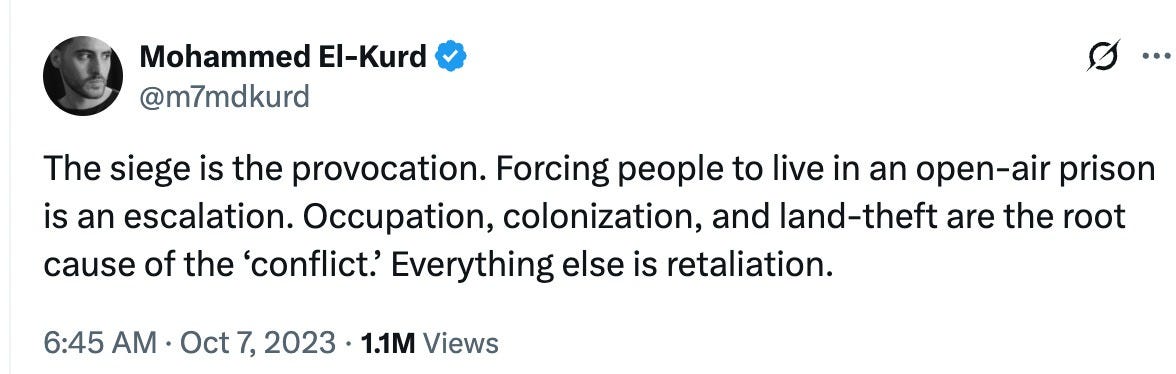
In 2021, El-Kurd posted frequently to X denying Jewish indigeneity to Israel, comparing Zionism to genocide and Nazism and comparing Israelis to Nazis. In his book of poetry, also published in 2021, El-Kurd claims that Israelis harvest and eat Palestinian organs.
But for PARCEO, this does not count as antisemitism.
It should surprise exactly no one familiar with postmodernism in Critical Theory that the first order of business is to first capture the language and then invert key terminology. An example might be to fight racism, we introduce anti-racism that is racism on steroids favourable only to the claimed 'victim' group. The same is happening with CT curriculum aimed at anti-Semitism that is anti-Semitic to its core and favourable only to those who are anti-Semitic. And so many will continue to be absolutely duped by this tactic and feel righteous only if they support the anti-Semitic ideology in play. In the name of anti-Semitism.
This training seems like an attempt to water down the existence of anti-semitism as a unique and specific phenomenon by contextualizing it and relativizing it to the point that it becomes unremarkable or subsumed into a general oppression narrative which has more to do with tearing down Western civilization and establishing a revolutionary utopian politics than it does with actually helping Jews. I'm reminded of the quote David Horowitz shared from an SDS radical: "The issue is never the issue, the issue is always the revolution."