
“That’s An Open Door”: CODEPINK Presenter Explains How To Bring Anti-Israel Lessons Into Classrooms
The webinar featured lessons promoted through the American Federation of Teachers’ Share My Lesson platform and pointed to California history standards as a pathway for anti-Israel lessons

QUICK TAKE-AWAY:
Marcy Winograd used the webinar to promote lessons hosted on the American Federation of Teachers’ Share My Lesson platform, including lessons on IHRA and South Africa’s genocide case against Israel.
Winograd described state history standards as an “open door” for bringing anti-Israel lessons into the classroom, even when those lessons involve deeply contested political advocacy.
CODEPINK’s final session opened with the goal plainly stated: bring “revolutionary language” into the classroom.
FULL STORY:
The final session in CODEPINK’s “Challenging Zionism In Our Schools” webinar series was an extravaganza of historical and factual inaccuracies, “how to effectively and safely bring in revolutionary language into our classrooms”, and dreams of a one-state solution only after the “genocidaires”were punished for their crimes.

The “Genocidaires” Will Be Punished
Dr. Maha Nassar, an associate professor in the School of Middle Eastern and North African Studies at the University of Arizona, spoke first about the meaning of “From the River to the Sea.” There were many, many inaccuracies in her presentation. However, it is worrying indeed that Nassar advises school districts and offers professional development training to K-12 teachers.
…this lesson is also drawn from my conversations that I’ve had with university and high school administrators as they’ve been trying to navigate what they see as the tension between free speech and hate speech. And so they’ll bring me on to try to explain the phrase to them where I then take on the role of having to explain to them why this is protected political speech and why attempts to silence or criminalize the use of this phrase essentially amounts to a silencing of the Palestinian narrative and the Palestinian call for freedom.
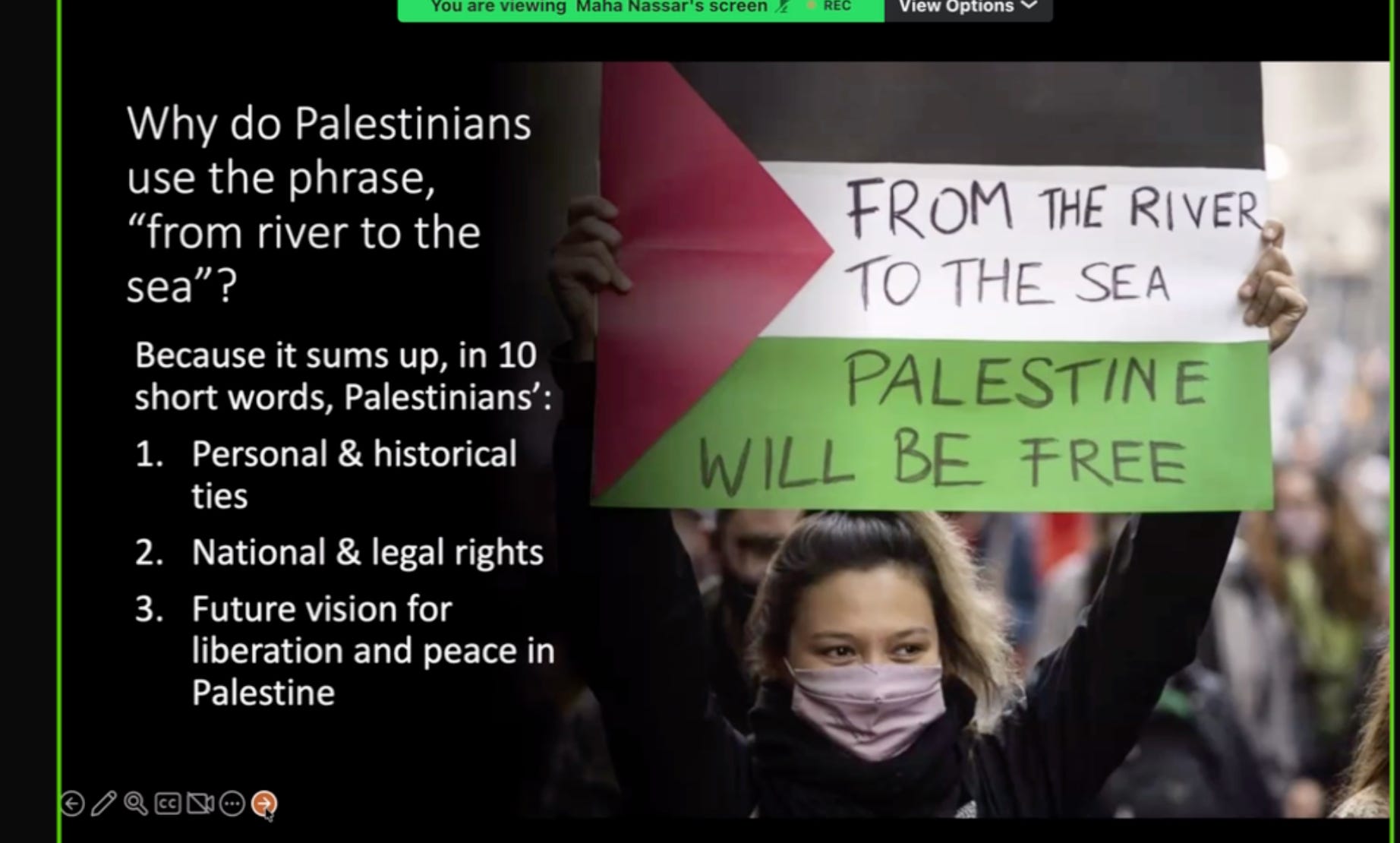
Nassar defends “From the River to the Sea, Palestine Will Be Free”, essentially a call to eliminate Israel, on the basis that it “sums up” Palestinians’ “personal and historical ties,” “national and legal rights,” and “future vision for liberation and peace in Palestine.”
She began by arguing that Palestine has long existed as a distinct political entity.
So turning to the personal and historical ties first. First we need to get a little bit of a basic grasp of geography. Many of you are familiar with the geography of Palestine, but it's worth reviewing right now, and it's also worth reviewing the history of this geography. So I have here on the screen two maps from the 1800s. The map on the left is a map from 1843 by a British cartographer named William Hughes called the Map of Palestine. You can see it right there. And the map on the right is from 1898. It's in Arabic, published by a Palestinian author named Khalil Beidas, called the Topographical Map of Contemporary Palestine or Modern Palestine. So both of these are recognizing Palestine as a political entity in the 19th century.
What are they describing as Palestine? Where is Palestine being delineated? You have on its west coast, Palestine is bordered by the Mediterranean Sea, and then you have kind of on the east coast or on the eastern border, but not exclusively. You have the Jordan River, which runs up and down here from the Dead Sea up until the Sea of Galilee, and you have it here from the Dead Sea up until the Sea of Galilee. So the river that we talk about in this phrase is the Jordan River that runs along the eastern portion. And then the sea is the Mediterranean Sea that runs along the western coast. So Palestine historically, even though various empires placed it under various types of administrative rule as part of the collective understanding of the people who lived there, Palestine or Philistine and Arabic was recognized as a distinct geographical entity that was situated between Syria in the north, Syria and Egypt, or Musser in the south. So Palestine is part of a larger geography that's sometimes referred to as greater Syria or the Levant, but it is distinct.
This is wrong. The maps show that “Palestine” was used as a geographic and historical term in the 19th century, not that it existed as a distinct political entity. Under Ottoman rule, there was no single province or sovereign unit called Palestine; the territory was divided among Ottoman administrative districts.
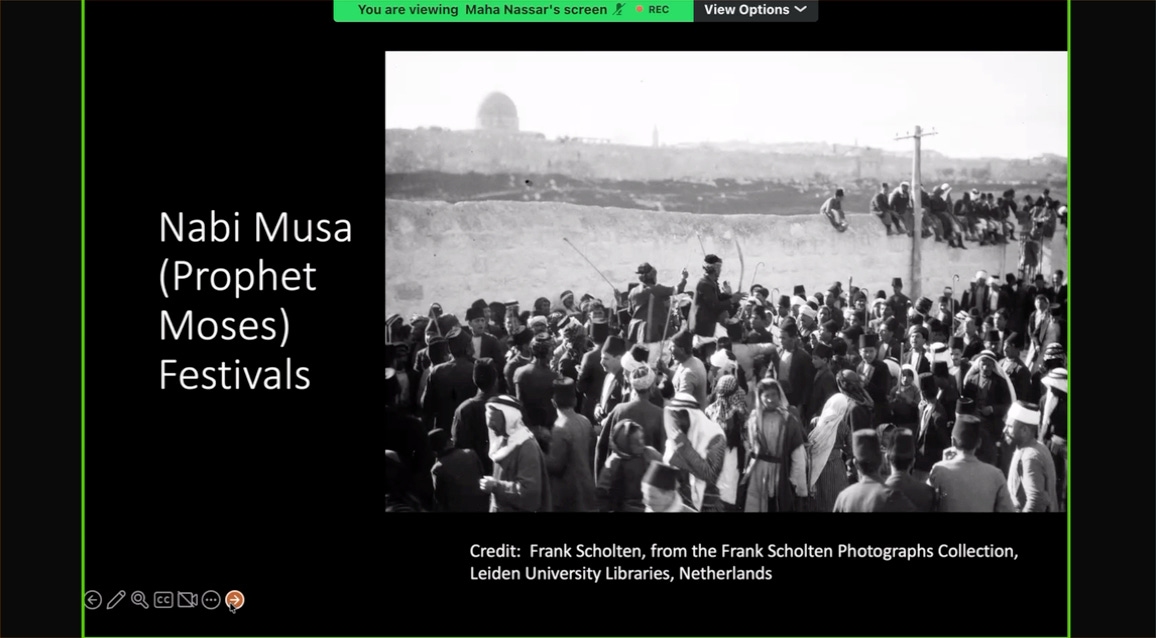
Nassar then turned to Palestinians’ religious connection to the land:
We know about Jerusalem’s significance for Muslim, Christian and Jewish worshipers and for Palestinians themselves. But there were also historically distinctive Palestinian cultural, religious and folk traditions that connected Palestinians to Jerusalem, not just as an abstract concept, but again as a lived tradition. What you're looking at here is a photograph from the Nabi Musa festivals. Nabi Musa means prophet Moses. And this was a nationwide or Palestine-wide celebration series, annual festivals that would happen in the springtime, celebrated by Muslims, Christians and Jews. That again, was very locally based but also tied to Palestine.
This is a great mischaracterization of the Nabi Musa festival. It was a Muslim pilgrimage, timed to coincide with the Christian Easter season. It was not a joint Muslim, Christian and Jewish celebration. Nassar also omits the 1920 Nabi Musa riots, in which Arab mobs attacked Jews in the Old City of Jerusalem.
Moving to “national and legal claims,” Nassar argued that the Palestinian “right of return” is “enshrined in UN Resolution 194.”
So the first legal basis is international law, and specifically General Assembly Resolution 194 that was passed shortly after in December of 1948, that affirmed that Palestinian refugees wishing to return to their homes and live at peace with their neighbors should be permitted to do so at the earliest practicable date. And that compensation should be paid for the property of those who choose not to return and for the loss or damage of property, which, et cetera, et cetera. So the right of return is enshrined in UN Resolution 194. It is enshrined in the Fourth Geneva Conventions. It is enshrined in the International Declaration of Human Rights. People, when they're expelled from their lands or their homes, which usually happens in times of war, once that war is over, people return to their homes.
These are not “enshrined” in law. UN General Assembly Resolution 194 is not a binding law, it is a non-binding resolution. The Universal Declaration of Human Rights (not the “International Declaration of Human Rights”)…well, the clue is in the name - it is a declaration, not binding treaty. The Fourth Geneva Convention does not talk about a “right of return.” And crucially, UN Resolution 194, the UDHR and the Fourth Geneva Convention say nothing of whether the “right of return” would apply to the descendants of refugees.
Nassar then gave a brief history of the Palestine Liberation Organization.
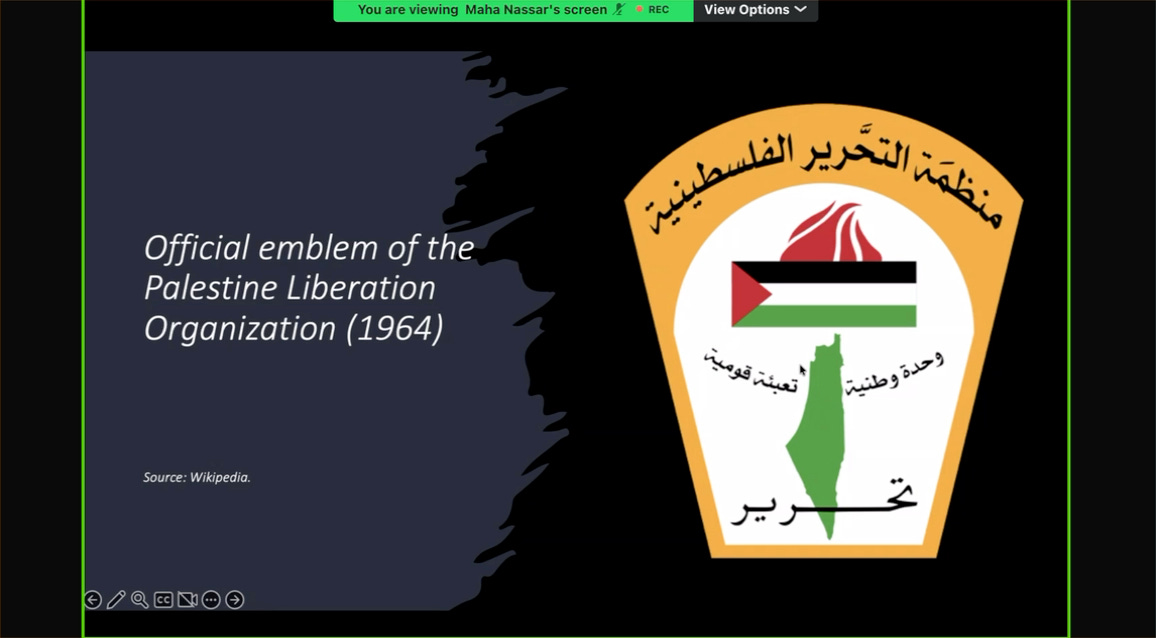
She explained that the PLO emblem shows Palestine “from the river to the sea,” with the word “liberation” written across it. In other words, the core territorial-political formulation was already present in Arab and Palestinian nationalist movements in the 1960s. Which is why it is particularly odd that a few moments later Nassar says Likud, the right wing Israeli political party, was the first to use the phrase.
She said that “Israel occupied the remainder of Palestine in 1967. Israel occupied the West Bank,Gaza Strip, East Jerusalem in 1967, thereby putting all of Palestine from the river to the sea.” Nassar skips over the fact that these territories had never been under “Palestinian” control and had been controlled by Jordan and Egypt respectively.
She also said that the the Palestinians were willing to enter into a two state solution in the 1970s….which is odd because the PLO did not formally accept Israel’s right to exist until the 1990s.
Nassar referred to Gaza as a “genocidal concentration camp.”
Nassar was asked how a one state solution could be feasible now that Israel has “committed genocide.”
What hope is there now that Israel has committed this genocide, how can we expect people who were the victims of this or who lost family members whose children have been made deaf from all the bombardment to live with their genocides? Is that really realistic or desirable?
Nassar answered:
I think there would have to be, in any future that’s going to see a free Palestine, there will have to be mechanisms for justice and accountability that will include war crimes tribunals, that may include international tribunals. We have mechanisms for restorative justice and transitional justice already in place. They’ve been applied elsewhere and they will have to be applied here. I suspect many of the genocidaires will not want to live in a free Palestine and may elect to leave so that they don’t have to confront the victims of their genocide. I think that I agree with you that it is a long path forward and that many people, including many Palestinians who may have once believed in some mode of coexistence, are asking that exact question. It would be like, how does the family of a murder victim live with the murderer?
Of course, there was no talk of any “accountability” or “punishment” for Hamas’ crimes. No talk of Hamas at all. Interestingly, the Zoom chat picked up where the presenters left off.
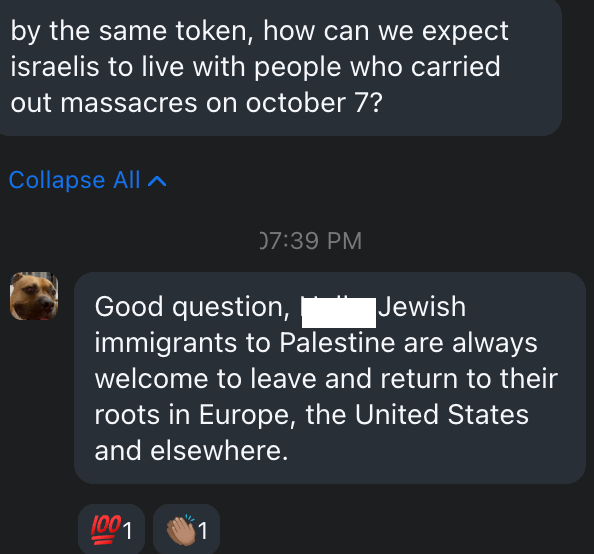
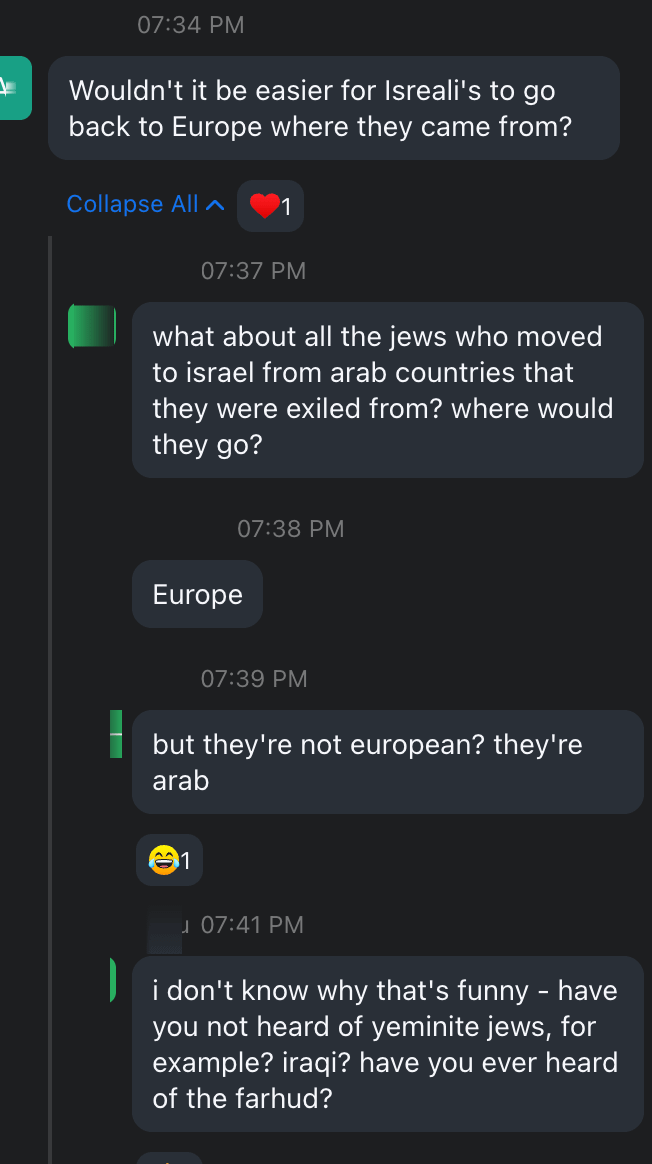
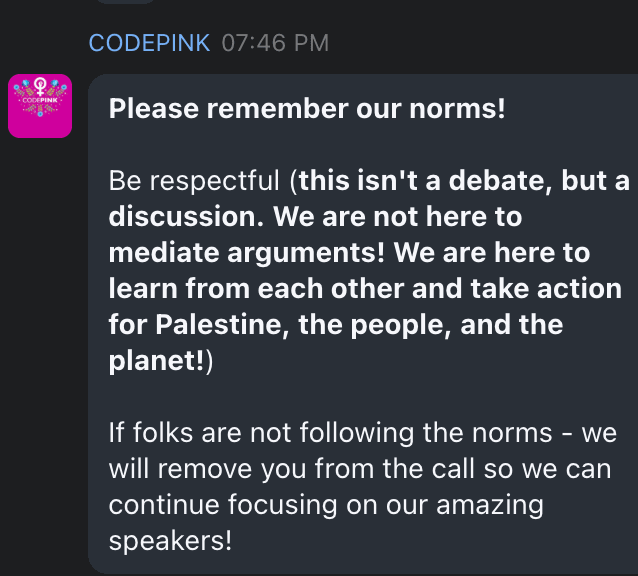
CODEPINK had to step in and threaten to kick out people stirring “debate.”
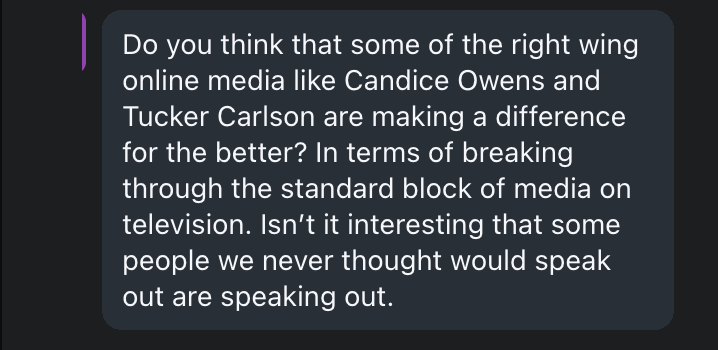
Nassar, Winograd and even some of the Zoom participants echoed rhetoric commonly associated with the far right, suggesting that the United States itself must be “liberated” from Israeli influence.
We do need to liberate the United States and return it to its original, I dunno if original is the right word, but to its ideal function of serving the American people and not serving the whims of Benjamin Netanyahu or an increasingly fascist Israeli government. I agree that that would be very helpful for the liberation of Palestine if the United States were also liberated.
After Nassar’s presentation, Winograd once again presented lessons freely available on the American Federation of Teachers “Share My Lesson” website.
Winograd mentions that her lessons had been briefly removed from the Share My Lesson website before she successfully lobbied to have them reinstated. She did not elaborate on why they had been briefly removed from the website.
The first lesson she discussed asks students to lobby or debate their school board on whether to adopt the IHRA definition of antisemitism.

This is a school board and students debate the IHRA definition. Does it conflate anti-Zionism with antisemitism? That's obvious. Yeah. The IHRA definition, for those who may not be familiar, I think most of us probably are, it's the International Holocaust Remembrance Alliance definition and examples. There are 11 examples, and most of them identify some form of criticism of Israel as antisemitism. And although Congress, the Israel lobby, has not been successful in pushing this and codifying it at the congressional level, but they have at some of the state level and some at the local level, and it's with school boards. And they're trying to do this right now in California, always going through a back door and not really being explicit about what they're doing, but we know what they're doing.
The next lesson focused on South Africa’s genocide case against Israel at the International Court of Justice.
Winograd then explained how teachers could use California’s 10th-grade history standards to bring the topic into class.
It's a history standard, which says students analyze the international developments in the post-World War II world, and they specifically mention in the subheadings under this standard that students should analyze the developments or the ramifications and the effects of the establishment of the state of Israel. Well, that's an open door. Let's do it. Let's talk about it. And if somebody challenges us, we'll go right back to this standard. Are you telling us not to teach what you are telling us to teach? Come on.
This is the “fugitive pedagogy” activists often celebrate: a form of malicious compliance in which broad state standards become cover for smuggling activism and political agendas into the classroom. In a previous webinar, teachers were instructed to use the language of social-emotional learning standards to justify incorporating Palestine into instruction.
This webinar wrapped up a week which demonstrated CODEPINK’s centrality to anti-Israel activism in K-12, through its connections with groups like Rethinking Schools and the Liberated Ethnic Studies Model Curriculum Consortium, and its growing influence within, at the least, the California Teachers Association.
CODEPINK’s “Challenging Zionism In Our Schools” series ended by saying the quiet part out loud. The goal is not simply to discuss Israel and Palestine in class. The goal is to equip teachers with the language, lesson plans and institutional cover to bring anti-Israel activism into the classroom.
This should be a concern not only for Jewish parents worried about the explosion of antisemitism in our schools but any parent who does not want to see their children turned into pawns for CODEPINK’s radical politics.
Sample Flyer:
———
From the Atlantic to the Pacific American Will be Radical Islam Free
Freedom of Speech Works Both Ways
Great to see some push-back from those in attendance.