
The Money Behind The Progressive Caucuses Capturing Teachers Unions

“Progressive” caucuses within teachers unions have been pushing for their unions to reject traditional concerns like labor conditions, contract negotiations and other matters to do with fairly representing workers. Instead these caucuses are encouraging unions to embrace the idea of “social justice unionism,” the idea that the primary function of a union should be to engineer social justice - or more precisely, social justice as defined by a particular strain of the left. This new purpose of the union is not to represent its workers but rather to encourage them to be footsoldiers in social revolution.
The Chicago Teachers Union (CTU), led by members of the Caucus of Rank and File Educators (CORE), operates on a “social justice union” model. And the success of CORE has meant that its model has been broadly embraced by progressive caucuses across the country.
Educators for a Democratic Union (EDU) in Massachusetts, for example, has produced the last three presidents of the Massachusetts Teachers Association. The Movement of Rank and File Educators in New York presented a real challenge to the “moderate” slate, which only won re-election by the narrowest of margins in the United Federation of Teachers’ latest elections.
Election campaigns, “organizer training,” retreats, and the many efforts needed to form a successful caucus capable of taking over a teachers union in the way that CORE did with CTU costs money. Enter the Social Justice and Solidarity Fund.
The Social Justice and Solidarity Fund
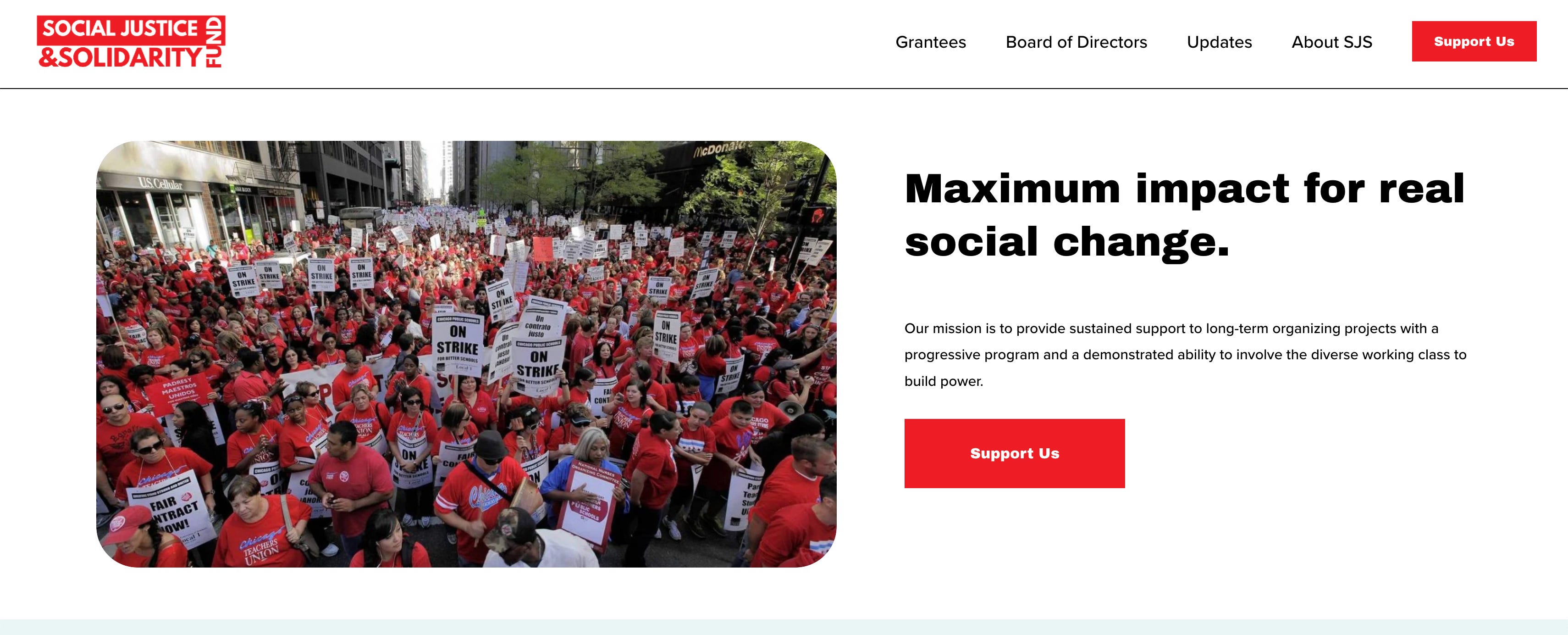
A major source of funding for Rank and File Caucuses is the Social Justice and Solidarity Fund (SJSF).
SJSF has provided thousands of dollars in grants to the EDU, MORE, VCORE (Virginia Caucus of Rank and File Educators), and UCORE (the United Caucuses of Rank and File Educators).
In 2023, SJSF gave UCORE a grant of $150,000. The next year, in 2024, it gave a grant of $15,000 in aid of UCORE’s annual conference.
In 2024, SJSF gave VCORE a first-time grant of $103,000.
In 2025, EDU and MORE were also first time grantees.
The People Behind SJSF
The SJSF board of directors has ties to the Democratic Socialists of America (DSA), the International Socialists (IS), and Labor Notes - a “media and organizing project” for union activists founded by members of the IS.
SJSF’s board of directors are Pam Galpern, Ken Paff, Johanna Parker and Jane Slaughter.
Ken Paff is on the board of Labor Notes and is one of the founders of Teamsters for a Democratic Union (TDU). Interestingly, Paff has come in for criticism from more activist members of the TDU, particularly after its 2023 convention where Paff and others stopped a resolution against Israel from being brought to the convention floor.
Pam Galpern, another member of the board of directors, gives seminars on strikes and “How to Build a More Militant and Effective Labor Movement” for the NYC-DSA Academy for Socialist Education.
Jane Slaughter is co-founder of Labor Notes.
“Labor Notes has worked closely behind the scenes with the teacher-union activists who’ve built strike movements around the country and helped set up and staff United Caucuses of Rank and File Educators.
Labor activists in DSA look to Labor Notes for training and inspiration, and they share tactics and swap notes at Labor Notes events. Many Labor Notes staff are also DSA members.”
Slaughter on growth of rank and file activism in K-12:
“We were initially focused on the blue-collar unions where rank-and-file movements were active then, and now we find that it’s K-12 teachers who are leading the charge.”
Slaughter is a member of the Detroit branch of the Democratic Socialists of America and a member of the DSA’s Bread and Roses caucus.
Bread and Roses is a “national caucus of Marxist organizers” within the DSA.
Excerpt from attendees’ experience at the 2023 DSA convention (at which Zohran Mamdani gave a keynote address):
The Rochester delegates sat together, and were pleased to have Jane Slaughter of Labor Notes fame sit with us for a while. One topic of deliberation was whether DSA should move from an exclusive focus on a rank-and-file strategy to also working with establishment union leaders. Comrade Jane’s aura prevailed, and our delegation (and, indeed, two-thirds of all delegates) voted against the change.
One meal time I happened to sit with Jane Slaughter, now a member of Detroit DSA. I first met Jane in the 1980s, when we were in NAM and she and her comrades in the International Socialists respectfully left because they thought we were insufficiently committed to a strategy of concentrating on heavy industry. Now together in DSA, we celebrated our growing convergence with Labor Notes on a pragmatic rank-and-file strategy.
(emphasis added)
In 1993, Slaughter was a signatory to the U.S. Committee for Democratic and Human Rights in Russia, along with Angela Davis and Noam Chomsky.
Slaughter was in the International Socialists and then formed Labor Notes with Mike Parker who co-founded the Social Justice Solidarity Fund.
In an interview to memorialize Parker, Slaughter said the following about International Socialists’ strategy, one that has now been adopted by the DSA:
The International Socialists were a small group of activists who initially had been active mostly in campus struggles. They had a strong vision of socialism from below. They rejected the way the Soviet Union had turned out and knew that that was a top-down system that they were not trying to organize towards.
They could see that socialist ideas were held by only a tiny minority of people in the United States. And they were trying to figure out, how do we help socialist ideas grow in the working class? Because of course, we knew that it’s the working class that has to fight to end capitalism and replace it with socialism. So one of their ideas for organizing the working class was that these young people would get working class jobs.
And they did it in a very strategic way. They tried to figure out which industries were most important and which unions were most important. And therefore people got jobs as auto workers, as steel workers, as Teamsters, as telephone workers, and also some teachers…
…We would meet the natural leaders who already existed inside these working class organizations, and struggles would grow. People’s consciousness would grow. And out of that, we could build more of a socialist movement.
Parker’s daughter, Johanna, is board president of SJSF. Parker bequeathed start-up capital for the fund. In February 2023, SJSF reported that “we have over $1.2 million, so this has been a very productive two-month period. This influx includes the final installment of funds that SJS co-founder Mike Parker left to Johanna Parker.”
In November 2024, thanks to wise investments in Vanguard mutual funds, SJSF reported assets of $2 million.
In SJSF’s August 2025 update, it notes that it has awarded $1 million in grants since its founding and it expects its grant total for 2025 to be in the range of $700,000.
Contributors to the SJSF include a standing donation of $200,000 through the Jewish Communal Fund and money from the 128 Collective (which has also provided grants to the Tides Foundation, Jewish Voice for Peace and the Working Families Party).
SJSF Grantees
VCORE: The Virginia Caucus of Rank and File Educators (VCORE) runs free trainings on organization in order to create a “network of education workers who are leaders in their unions, schools, and communities.”
The organizer training offered by VCORE is similar to the one advertised by the Detroit branch of the DSA and run by Jane Slaughter.
VCORE also provides a handout, “Alinsky for Teacher Organizers,” based on the author of “Rules for Radicals” Saul Alinsky’s roadmap on political organizing within teacher unions. The handout provided by VCORE was written by J. Michael Arisman, Midwest Training Consultant for the National Education Association.
The handout includes the following:
When he talks to teacher organizers, he talks community organizing. Alinsky believes that the teacher association’s real power base is not in the teachers, but in the community… Because he sees the teacher’s power base outside the membership and in the community, Alinsky offers a straight line route to organization of that power base:
1. Forget the older teachers four or five years from retirement. They will fight organizing. 2. Find one or several local teacher leaders.
3. Get those teacher leaders to organize the community to put pressure on the superintendent or the school board to get things done for education. Develop a multi-issue base in getting to the community. Local taxes, for example, is an issue teachers could use to organize other community elements.
4. Organize the community by using the natural interest in the children to get into the homes. That is, send teachers into the homes. Once teachers show interest in kids by visiting homes, they develop a relationship with parents.
5. Once one or two teacher leaders begin to push and get near community wide success, the rest of the teachers will go along…
…In other words, in the building of a power base, a leader initially is more important than the number of people that you have behind him. Among others, Martin Luther King, Ho Chi Minh, and Fidel Castro, suggest the wisdom of this advice…
…2. The real training does not take place with words, but only with actions, which means that in order to train leaders the organization must set enough brush fires to keep them active and to keep the action going.
3. Everything is in the action. The organizer must use his imagination to set his people into action in order to train them…
…What you can’t train, but which is very much a part of the Alinsky method of organizing, is to seize the moment. If your job is to train leaders, Alinsky says, you must be lucky enough to have your people insulted or assaulted (verbally) by the other side. This helps to accomplish your training task. One can’t count on the other side insulting your people, but the idea is that if you keep your people in action, if you are constantly assessing, constantly pushing, eventually the other side is going to help by insulting them. Action is critical, especially with the white middle class. This group is not used to action. It will want to quit after the first time, which means the training of leadership stops…
…Alinsky has a very simple method for preparing your people tactically. He advises that you go into little battles you can win first, in order to build up your people’s confidence. He advises that later you make alliances that get you bigger battles.
In fact, this is very much akin to what he talks about in the training of your people. His primary tactic is to get into action to stoke the brush fires, to get your organization alive, and keep it alive. Again he says everything is in the action — the organizer must use his imagination to get them into action. The worst thing the organizer can do in terms of tactics is to get together with his people and lay out a structured campaign because the structured campaign allows you to rationalize failure and to stop the action any
time you run into a barrier…
…In the matter of tactics, Alinsky is very much for developing tactics that are so exciting your people want to get involved in them. His books on the subject of organizing suggests the kind of tactics he is talking about. Certainly Alinsky would not recommend exchanges of letters or private discussions with the superintendent as a way of building the organization. Such meetings, or such correspondence might solve the problem, but they would not provide the kind of action that is exciting and what makes your people want to get involved with the organization to participate…
…Generally, the Alinsky advice on tactics is guerilla war advice. To win, know the enemy, divide the enemy. Know who all the players are, conduct the action on several levels and personalize the conflict. It is hard to deal with an enemy with whom you have a personal relationship. You should not let your people fraternize with enemy. Distance helps you to polarize the issue – to make it an us – them affair.
When you are starting with little issues, you can’t afford too many losses. This means you must “fix” the outcome of these fights. Find out what the establishment will give you without a fight and then send your people in to take it from the establishment. If the superintendent tells you the teachers can have a lower class size send a delegation to the superintendent demanding the class size he has conceded. The superintendent will say, “but I already agreed to that.” And the leaders say, “well, if that’s true you won’t
mind putting it in writing.” They can then say to the teachers, “he says he was giving it to us anyway, but we made him put it in writing.” That’s a victory in a fixed fight.
(emphasis added)
VCORE released a resolution on what it calls “Israel’s war on Gaza.”
Whereas VCORE stands against all forms of exploitation and oppression, and locates the root cause of racial and national oppression within the global system of capitalist-imperialism…
…VCORE believes that:
These latest attacks are a continuation of more than 75 years of Israeli crimes committed against the Palestinian people, including belligerent occupation, settler-colonialism, and apartheid;
Israel’s actions and escalation are enabled and facilitated by the impunity afforded it by the international community–particularly the U.S. government–who provide it with the weapons, machinery, and technology to maintain its illegal occupation and to undertake its attacks;
As members of the labor movement we must always stand on the side of truth, freedom, and justice, both in word and in deed; and
Lobbying our governments and issuing statements must be coupled with labor action, ensuring that we are practically contributing to the struggle for Palestinian liberation.
VCORE’s “Points of Unity” include:
Public education can revolutionize people’s lives. But rarely are U.S. educators called upon to take revolutionary action in order to defend and transform public education…And for many students, our public education system prepares them for a life of drudgery at best, or domination at worst. From socializing the next generation of obedient workers to reproducing racial inequality and white supremacy through the school-to-prison pipeline, our public education system is in dire need of revolutionary changes. We are not afraid to say: it is time for a revolution in public education…
…for too long unions have been afraid to take militant action to defend and transform public education. To win the fight for higher pay, safety, fairness, dignity, and respect - let alone a public education system that serves the people - we must build tight-knit networks of workplace organizations, which mobilize our colleagues and communities in struggle…
…1. For Class-Struggle Unionism
Public education workers - including classroom teachers, counselors, paraprofessionals, office workers, nurses, cafeteria staff, bus drivers, and janitors - are part of a global working class. As members of this class, we have a common interest in uniting with all workers through the organized labor movement in the struggle to win material improvements in our working and living conditions. In the course of this struggle, we must organize to overcome social divisions within the working class by struggling against all manifestations of racism (including but not limited to white supremacy, anti-Blackness, Islamophobia, and anti-Semitism), sexism, homophobia, transphobia, and ableism among our fellow workers, while simultaneously expanding workers’ capacities to democratically govern society. We support all efforts to promote the growth, development, and unity of a fighting labor movement at the local, state, national, and global level through networks and federations of workers’ organizations, and stand in solidarity with the struggles of all working people. An injury to one is an injury to all!
2. Against All Forms of Exploitation and Oppression
We are against the exploitation of workers by capital, and uphold the importance of struggling against all forms of systemic oppression based on race, ethnicity, nationality, gender, sexuality, ability, religion, and age, which are themselves produced and reinforced by global imperialism, and advocated by fascism. We recognize that the struggle waged by education workers constitutes only one front in a larger multi-sector movement for liberation. Nonetheless, we recognize that schools are of central importance for the reproduction of the dominant social relations. From fighting racial oppression by ending de facto school segregation and the school-to-prison pipeline, to refusing to socialize a new generation of well-behaved workers prepared to follow orders and accept poverty wages, education workers must accompany and participate in the liberation struggles of our students and school communities.
(emphasis added)
UCORE: The United Caucuses of Rank-and-File Educators is a national network of Rank and File Caucuses within teachers unions across the country. Since 2013, UCORE has held an annual conference for caucuses to network, strategize, and organize together. The conferences appear to be organized and run through Labor Notes, an organization for which Jane Slaughter is also on the board. UCORE also carries out regional trainings and holds monthly meetings.
MORE: The Movement of Rank and File Educators (MORE) of the United Federation of Teachers (UFT) is part of the Racially Just Public Schools coalition - a coalition of activist groups which seeks to influence education policy within New York City. In 2022, the RJPS argued that using test scores or grades to separate students into “tracks” like honors programs is segregationist. RJPS also believes that “objectivity and worship of written words” is white supremacy (RJPS is linked to politicians Jamaal Bowman, Shahana Hanif and the chair of the New York City Council Committee on Education, Rita Joseph.
MORE canvassed for and endorsed Zohran Mamdani for NYC mayor. The MORE caucus mounted a serious challenge for UFT leadership, losing by a narrow margin. After the elections, UFT endorsed Mamdani.
MORE’s “Points of Unity” include:
Education For Liberation
We value pedagogy that is student driven, developmentally appropriate, and honors students, families, and communities. We call for the dismantling of corporate driven high-stakes testing that is rooted in racism and eugenics. Our classrooms should be centers of liberation that help students celebrate their full humanity
We Build Coalitions and Fight Alongside Allies
We build coalitions with organizations and communities that organize for the common good. This includes our siblings across the labor movement, communities of color, disabled people, undocumented people, LGTBQ+ people, and all oppressed peoples. We center those most threatened by the oppressive systems we seek to change as we fight for more just and equitable schools and curricula.
Ethical Investments and Opposition to Militarism
Recognizing the devastating impact of militarism on children, education, and societies globally, we advocate for the boycott and divestment from governments, corporations, and institutions complicit in militaristic practices and human rights abuses, specifically we want to divest our pensions and resources from those entities that profit from or contribute to warfare and human rights abuses.
Aside from canvassing for Mamdani, MORE has DSA members within its ranks. Indeed, the NYC branch of the DSA identified the MORE caucus as the best entryway into gaining power over the UFT, because of the many members of DSA within MORE.
Members of MORE also constitute the NYC Educators for Palestine group. MORE advertises the group’s meetings and events on its public calendar.

EDU: The Educators for a Democratic Union caucus has produced the last three MTA presidents and vice presidents. Barbara Madeloni, Merrie Najimy, Max Page and Deb McCarthy were all members of EDU.
The EDU states quite clearly its goal to change the MTA “into an activist, social justice union.”
The EDU platform states: “Inspired by educators around the country, the foundation of our platform is to advance the struggle for racial, social, and economic justice.”
EDU members view education as “liberatory” and:
“pledge to address economic injustice, racism and oppression in our bargaining and all that we do; we will support politicians only to the extent that they stand with us in undoing decades if not centuries of economic and racial injustice and pledge to recruit, welcome, and support educators of color in our schools and in MTA’s leadership. We will work to dismantle structures of oppression within our union as well as other institutions.”
Madeloni now works for Labor Notes and has helped to organize UCORE conferences. Madeloni also runs the “Troublemakers Schools” for Labor Notes:
Troublemakers Schools and Workshops
We can bring the troublemaking to you! Labor Notes works with local unions and community groups to organize Troublemakers Schools, bringing labor activists in your city or region together for a day of workshops on grassroots unionism and skills that officers and rank and filers need. Check this site for announcements of dates and locations. Or if you’d like to help build a school in your city, email Barbara Madeloni
EDU members Madeloni and Najiimy were on the board of Massachusetts Education Justice Alliance (MEJA) while presidents of the MTA. In 2018, The Tides Foundation gave MEJA $10,000. Tides has funded many far-left extreme groups such as CodePink, IfNotNow, Jewish Voice for Peace, and National Lawyers Guild. MEJA’s fiscal sponsor is Resist,Inc.
Resist was formed in the late 1960s to provide support to anti-Vietnam War activists. Its founding members include Noam Chomsky and Howard Zinn. Resist funds National Students for Justice in Palestine, Palestinian Youth Movement and WithinOurLifetime.
A Plan Comes Together
The strength of the “rank and file” movement within teachers unions is not organic. It has been a deliberate organizing strategy pushed by members of the International Socialists and the Democratic Socialists of America. These members formed Labor Notes to put that strategy into action. Now, with these same members leading SJSF, “rank and file” caucuses pushing a radical political agenda will have even more financial backing behind them.
Wow ! Ken Paff has s still alive ! I remember him from nearly thirty years ago.